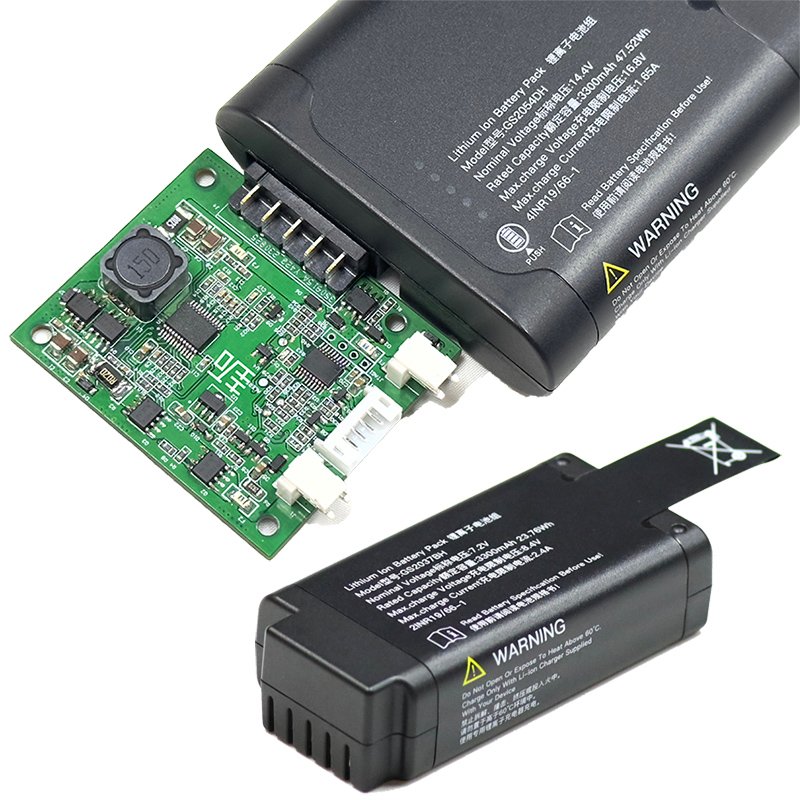
A returned battery pack should be treated as evidence, not as scrap or as a defective part to be replaced on sight. The diagnostic sequence is: preserve the returned state, record what the equipment reported, run non-destructive electrical checks against a defined reference, separate pack faults from charger and host faults, and only then open the pack or send it for teardown. A peer-reviewed review of lithium-ion battery failure classifies failure modes broadly into mechanical, electrical and thermal categories, and organises mitigation into measures taken during normal operation and measures taken after a failure (Materials, 2021, “Cause and Mitigation of Lithium-Ion Battery Failure”). That classification is the backbone of a triage workflow: most field complaints collapse into a small number of symptom families, each with a different first check. This article gives that workflow, the evidence to capture on receipt, and the rules that separate a pack fault from a system or handling fault.
Start by preserving the returned state
The most common way to lose a root cause is to charge the pack “to see if it works” before recording anything. Charging a pack with an internal short, a damaged separator or a cell that has been deeply discharged can change the evidence and, in a damaged pack, add risk. Before any test, log the unit identifiers, the equipment and firmware it came from, the reported symptom, the operating environment, the date the fault was noticed, and the pack’s terminal voltage and, if the BMS exposes it, the state of charge and any stored fault flags. Record the charger model and the load profile too, since a “no-charge” complaint is frequently a charger or host configuration issue.
Handle a pack that shows swelling, heat, odour, leakage or physical damage differently. Segregate it, do not charge or discharge it, and follow your site’s damaged-battery procedure. A review of thermal runaway monitoring describes the degradation pathways that can precede such a state, including loss of active lithium and rising internal resistance from SEI growth and lithium plating, and internal short circuits caused by dendrite growth, particle contamination or mechanical damage to the separator (Molecules, 2026, review of thermal runaway monitoring). Those mechanisms are why a returned pack with a thermal symptom is a safety case, not a bench experiment. When a suspect pack has to be shipped back for analysis, check the current IATA lithium battery guidance, which sets conditions for the air transport of lithium batteries, including damaged or defective ones.
Classify the symptom before you classify the fault
Arrange the incoming complaints into symptom families and give each one a fixed first check. The table below is a triage template; the checks are non-destructive and ordered so that the least invasive information is gathered first. Any numerical limits belong in your own acceptance document, agreed with the cell datasheet and the pack specification, not in this article.
| Reported symptom | First non-destructive checks, in order | Likely fault family to test next |
|---|---|---|
| Pack will not charge | Terminal voltage at rest; BMS fault flags and state of charge; charger output voltage and connector pinout; charge-enable or handshake signal; cell group voltages if exposed | Charger or host configuration; BMS protection latch; deeply discharged pack; open interconnect or thermistor circuit |
| Runtime far below specification | Capacity test at a defined rate, temperature and cut-off voltage; cell group voltage spread at rest and under load; compare with the incoming-inspection record for that lot | Capacity fade; cell imbalance; a weak cell group; load profile changed by host firmware |
| Pack shuts down under load | Peak and pulse current with duration; voltage sag at the pack terminals; BMS overcurrent threshold and delay; connector and harness resistance | Load exceeding the design point; BMS trip threshold; high-resistance joint; cell voltage sag at low temperature |
| Intermittent or missing battery data | Communication link, message IDs and scaling; fault flags; connector seating and harness continuity | Host integration or protocol mismatch; connector or harness intermittent; BMS reset |
| Swelling, heat, odour or visible damage | Stop electrical testing; segregate; photograph and document; follow the damaged-battery procedure | Safety case: escalate to the supplier with the evidence pack, do not attempt a bench diagnosis |
Two distinctions prevent most wrong conclusions. First, a measurement is only meaningful under defined conditions. IEC 61960-3:2017 specifies performance tests, designations, markings, dimensions and other requirements for secondary lithium single cells and batteries for portable applications, which is a reminder that rated capacity is a measured quantity with a stated method, not a number you can compare across different discharge rates and temperatures. Second, “electrical” and “thermal” symptoms overlap: rising internal resistance shows up as both reduced runtime and extra heating. Our battery pack cycle life datasheet verification guide describes how to compare a capacity claim against measured retention on the bench, and our incoming inspection article sets out the acceptance record that a field return should be compared against.
Separate the pack from the system
A field return is a system-level event. Before assigning the fault to the pack, reproduce the symptom with a known-good charger and a known-good host on the bench, and reproduce the pack with a known-good load. If the pack behaves normally with the reference setup, the fault is in the charger, the host firmware, the harness or the operating environment, not in the cells. If the symptom follows the pack across setups, keep it with the pack. This crossover test is cheap and resolves a large share of “dead battery” returns without opening anything.
The crossover result is easier to act on when the decision rule is written down in advance. The table below maps each observation to a conclusion; it is a decision template, not a substitute for the measurements described above.
| Crossover observation | Conclusion | Next action |
|---|---|---|
| Symptom disappears with a known-good charger or host | Fault is outside the pack: charger, host firmware, harness or operating environment | Raise a system-integration finding; document the check before returning the pack to service |
| Symptom follows the pack onto the reference setup | Fault is inside the pack | Complete non-destructive checks, then controlled teardown if the cause is still open |
| Symptom appears only at a stated temperature, load or firmware state | Out-of-envelope operation or a host-dependent condition | Compare with the declared operating envelope before calling it a manufacturing defect |
| Multiple units share a lot code, firmware revision or symptom | Possible batch or design pattern | Open a supplier investigation with containment, root cause, corrective action and verification of effectiveness |
Where the pack must be opened, treat teardown as a controlled evidence step: photograph each layer, record cell group voltages before disassembly, check interconnects and welds, and preserve the BMS board and its stored fault log. IEC 62133-2:2017+A1:2021 defines safety requirements and tests for portable sealed secondary lithium cells and batteries under intended use and reasonably foreseeable misuse, which is the reference frame for deciding whether a returned pack was used outside its specified envelope. A pack that was operated outside the declared charge temperature range, charge voltage or discharge rate is not a manufacturing defect, and the evidence pack should show that.
Build an evidence pack that a supplier can act on
A supplier can only run a root-cause analysis on the data you send. The table below is the minimum evidence set for a return, framed as fields to capture rather than as values to fill in. Where a dispute goes to third-party analysis, an accredited report carries more weight: mutual-recognition arrangements between accreditation bodies are the usual route for cross-border acceptance of accredited laboratory results.
| Evidence field | What to capture | Why it decides the outcome |
|---|---|---|
| Identity and traceability | Pack serial or lot code, cell lot if known, BMS hardware and firmware revision, date of manufacture and date of the fault report | Links the return to a production lot and reveals whether a cluster shares a batch or a firmware revision |
| Returned state | Terminal voltage, cell group voltages, state of charge and fault flags as received, before any charging | Preserves the evidence that charging would change; shows a protection latch or a deep-discharge state |
| Operating context | Load profile, peak current with duration, ambient and pack temperature, charge method, charger model, host firmware revision | Separates an out-of-envelope use case from a pack defect; the load profile, charge method and temperature define the declared operating envelope |
| Bench measurements | Capacity at a stated rate, temperature and cut-off voltage; cell spread; interconnect and connector resistance; method and instrument used | Comparable numbers with conditions attached; fix the measurement method before comparing populations of packs |
| Crossover result | Outcome with a known-good charger and host, and with a known-good load | Locates the fault in the pack or in the system |
| Photographs and teardown record | Exterior, connector, cell group voltages before disassembly, layer-by-layer photographs, weld and interconnect condition | Supports a teardown finding without needing the physical pack returned again |
That evidence pack also drives the corrective-action conversation. A single unit with a unique history is a field incident; several units sharing a lot code, a firmware revision or a symptom are a pattern that calls for a supplier investigation with containment, a root cause, a corrective action and a verification of effectiveness. Our battery pack supplier process audit article lists the process records that make that investigation verifiable, and the state of health and end-of-life guide covers how to distinguish normal end-of-life capacity loss from a defect before a warranty decision is made.
Questions that come up on real returns
Should a returned pack be charged first to check whether it works?
Not before recording its returned state, and not at all if it shows swelling, heat, odour, leakage or damage. Charging changes the voltage and state-of-charge evidence and can add risk to a damaged pack. Log the terminal voltage, fault flags and state of charge first, then follow the damaged-battery procedure where it applies.
How do we tell a capacity defect from normal aging?
Compare a measured capacity, taken at a defined rate, temperature and cut-off voltage, with the agreed end-of-life retention target and with the incoming-inspection record for that lot. A capacity figure without those conditions is not comparable. If the unit is near its agreed end-of-life threshold, the warranty question is a state-of-health question, not a manufacturing-defect question.
When is a third-party lab warranted?
When the fault is disputed, when the return is part of a cluster, or when a teardown finding needs to be accepted across borders. Use an accredited laboratory and require a report naming the method, conditions and configuration. If you need help defining a return-triage workflow for a specific pack programme, contact our engineering team.
A disciplined triage does two things at once: it resolves individual returns faster, because the crossover test and the symptom table remove the guesswork, and it turns scattered returns into a usable quality signal, because every unit carries the same evidence fields. The alternative, replacing packs on sight and discarding the returned state, keeps the RMA queue moving while guaranteeing that the same fault comes back.