
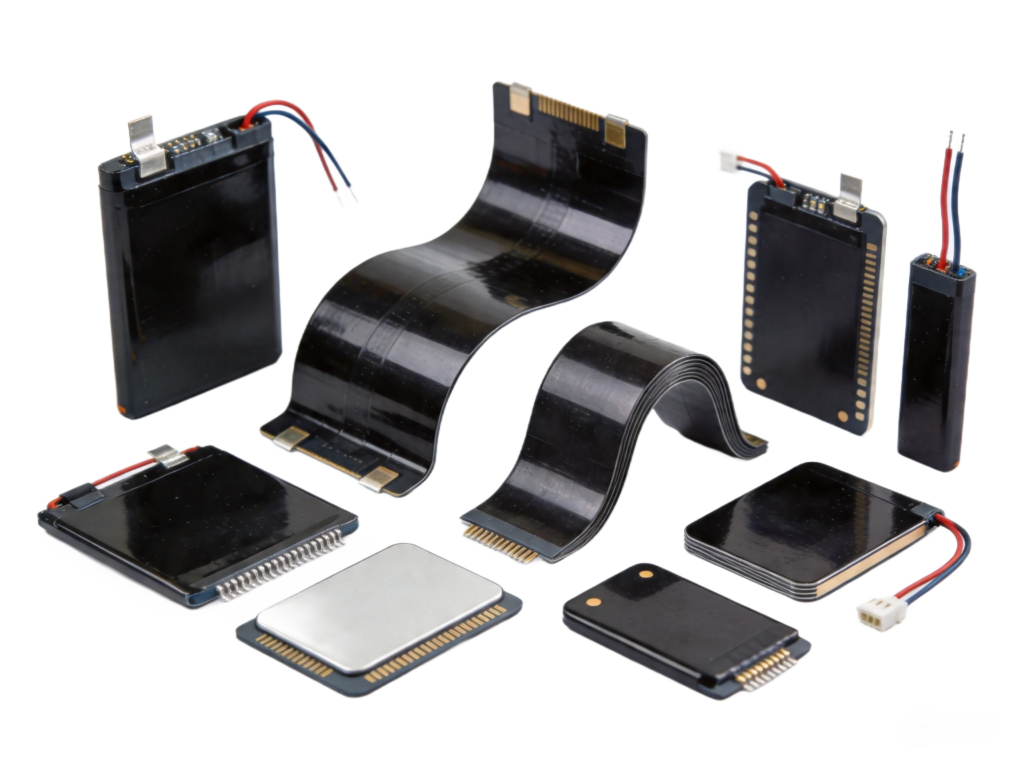
What is a Polymer Lithium Battery
Polymer lithium batteries (Li-polymer, also known as lithium polymer or soft pack batteries) represent next-generation energy storage technology. Featuring solid/gel electrolytes instead of liquid electrolytes, these batteries offer ultra-thin profiles, customizable shapes, and superior safety compared to traditional lithium-ion batteries. They are widely adopted in medical devices, wearable electronics, and consumer products.
6 Key Advantages of Polymer Lithium Batteries
1. Ultra-Thin Design
Polymer batteries achieve a minimum thickness of just 0.5mm, far thinner than traditional batteries’ 6-8mm limits. For a 3.6V 400mAh cell, thickness can be controlled at 0.5-1mm—delivering 80%+ volume reduction for space-constrained devices like smartwatches and wireless earbuds.
2. Flexible Form Factors
Aluminum-plastic composite packaging enables virtually any shape: ultra-thin card-style batteries for smart trackers, curved batteries for smart glasses, and custom C-shaped or L-shaped configurations for space-limited electronics. This flexibility provides greater creative freedom for product industrial design.
3. Bendable & Flexible
Lithium polymer batteries demonstrate excellent flexibility with maximum bend angles reaching 900 degrees. After 5,000 repeated bending cycles, capacity retention remains above 95%—making them ideal for flexible displays, smart clothing, and rollable electronic devices.
4. High-Voltage Single Cell Design
Unlike traditional liquid electrolyte batteries requiring multiple cells in series, polymer batteries achieve high voltage through multi-layer stacking within a single cell. This simplifies circuit design, reduces boost circuit requirements, and saves valuable internal space.
5. Superior Energy Density
Polymer lithium batteries deliver 50%-100% higher energy density than equivalent-volume traditional lithium-ion batteries. This means either significantly reduced size at maintained capacity or nearly doubled runtime at equivalent volume.
6. Exceptional Safety Performance
The most critical advantage: soft aluminum-plastic packaging replaces traditional metal casings. When internal abnormalities occur, pressure releases through gradual swelling rather than violent explosion. This “progressive failure” mechanism dramatically reduces safety hazards and makes polymer batteries the preferred choice for medical devices and other high-safety applications where user protection is paramount.
Why Choose Polymer Lithium Batteries
Product engineers and designers increasingly select polymer lithium batteries for their unique combination of form factor flexibility and safety performance. Whether developing next-generation wearable devices, compact medical instruments, or innovative consumer electronics, polymer batteries provide the design freedom needed to create truly differentiated products.
Polymer vs. Liquid Li-ion Comparison
| Feature | Polymer Li-ion | Liquid Li-ion |
|---|---|---|
| Min Thickness | 0.5mm | 6mm |
| Shape Options | Any shape | Cylindrical/prismatic only |
| Energy Density | 300-400Wh/L | 200-300Wh/L |
| Safety | No explosion risk | Explosion risk exists |
| Cycle Life | 500-800 cycles | 300-500 cycles |
Applications
- Medical: Patient monitors, wearable health devices, handheld ultrasound equipment
- Consumer Electronics: Smartphones, Bluetooth earbuds, smartwatches, e-readers
- IoT & Wearables: Asset trackers, smart clothing, environmental monitoring sensors
Contact Us
As a professional polymer lithium battery manufacturer, Huarui Xinchuang Technology Co., Ltd. delivers high-quality Li-polymer solutions worldwide.
Our Advantages:
- ✓ Free sample testing for all specifications
- ✓ Custom shapes, capacities, and voltage configurations
- ✓ 24-hour technical support response
- ✓ ISO9001, CE, UL certified quality assurance
📧 Email: nancy@hrlibattery.com | 📞 Hotline: 86-15112443431 | 🌐 www.hrlibattery.com
References: