
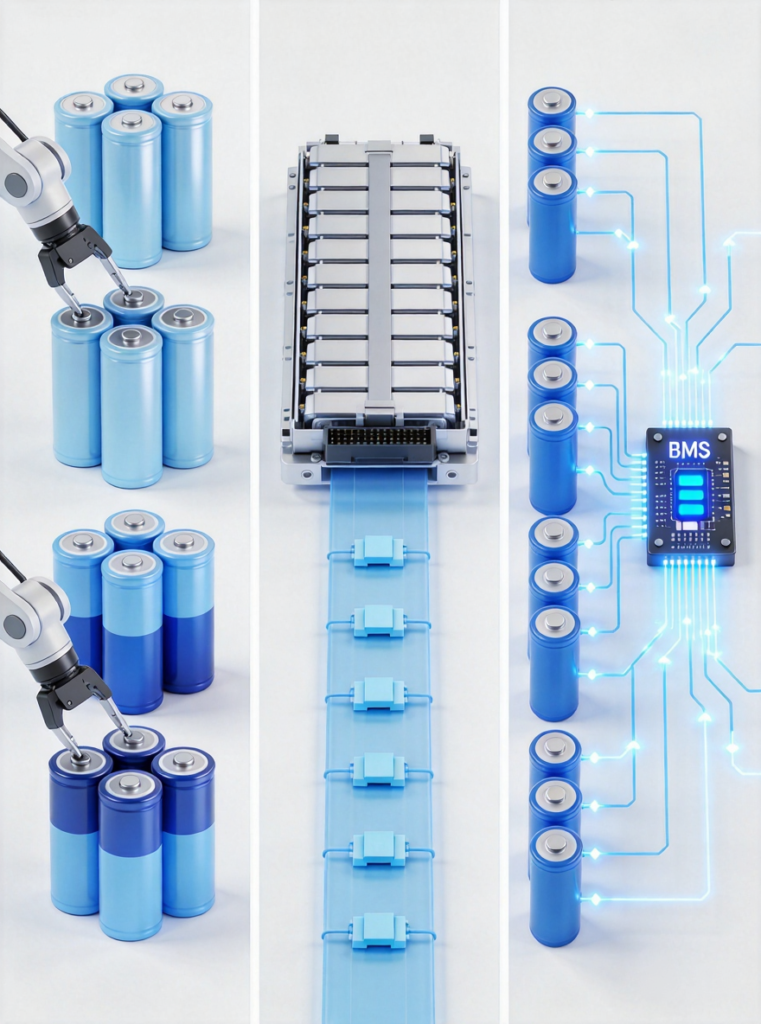
Lithium-ion batteries have established themselves as the dominant power source for electric vehicles, offering high energy density, long service life, and tremendous improvement potential. However, lithium battery consistency remains a critical factor affecting battery pack performance and longevity. This article explores the 3 key challenges of battery cell consistency and their systematic solutions.
Why Lithium Batteries Come in Small Packages
Unlike bulky lead-acid batteries, lithium batteries are compact by design. This difference stems from safety requirements: while lead-acid batteries achieve approximately 40Wh/kg energy density, lithium batteries exceed 150Wh/kg—a much higher energy concentration.
To mitigate safety risks, engineers equip lithium batteries with multiple protective mechanisms:
- Safety Valve: Automatically releases pressure when internal pressure exceeds design limits
- Thermistor: Resistance increases sharply at abnormal temperatures, limiting current flow
- Fuse: Rapidly disconnects circuits during overcurrent events
Despite these safeguards, lithium batteries with excessive single-cell energy face severe consequences if thermal runaway occurs. Therefore, manufacturers typically design smaller capacity cells and connect them in parallel to meet high energy demands.
3 Core Problems of Battery Consistency
When grouping numerous small cells into battery packs, lithium battery consistency issues emerge. Inconsistent parameters (capacity, internal resistance, open-circuit voltage) trigger cascading problems.
Problem 1: Capacity Loss – The Bucket Effect
The battery pack capacity is determined by the weakest cell. For two serial cells with capacities of 1C and 0.9C, the smaller cell reaches full charge and discharge first, leaving the entire pack underutilized.
Problem 2: Life Degradation – The Downward Spiral
Cells with smaller capacity experience repeated full charge-discharge cycles, “working overtime” and accelerating their end-of-life. When one cell fails, the entire string becomes unusable.
Problem 3: Increased Resistance – The Heat Cascade
Cells with higher internal resistance generate more heat during current flow. Elevated temperatures accelerate degradation, creating a negative feedback loop between resistance and temperature rise.
3 Solutions: Cell Matching, Thermal Management & BMS Balancing
Addressing battery consistency challenges, the industry has developed systematic strategies.
Solution 1: Scientific Battery Cell Matching
Battery cell matching is the first defense line for improving lithium battery consistency. Through static matching (voltage, resistance, capacity testing) and dynamic matching (charge-discharge curve analysis), cells with similar parameters are grouped together. Large-scale manufacturers can implement finer grading to obtain battery packs with more uniform performance.
Solution 2: Intelligent Thermal Management
Thermal management systems control battery pack temperature differentials through liquid cooling circulation or air cooling. Even cells with higher internal resistance maintain similar temperatures, preventing uneven degradation levels.
Solution 3: BMS Battery Management Balancing
When a cell’s voltage reaches the control threshold first, the BMS activates BMS balancing functions: either dissipating excess energy through resistors or transferring energy to lower-voltage cells. This removes charge termination limits and increases pack usable capacity.
Contact Us
Need professional lithium battery consistency solutions? Our technical team provides:
- 🔧 Customized cell matching solutions
- 🔧 BMS balancing strategy optimization
- 🔧 Thermal management system design consultation
- 🔧 Full-range lithium battery product support
📞 Contact Us Now:Get Technical Support
🌐 Learn More:Cylindrical Lithium Batteries
External Links:IEC 62660 Battery Standards | UL 2580 Battery Safety