
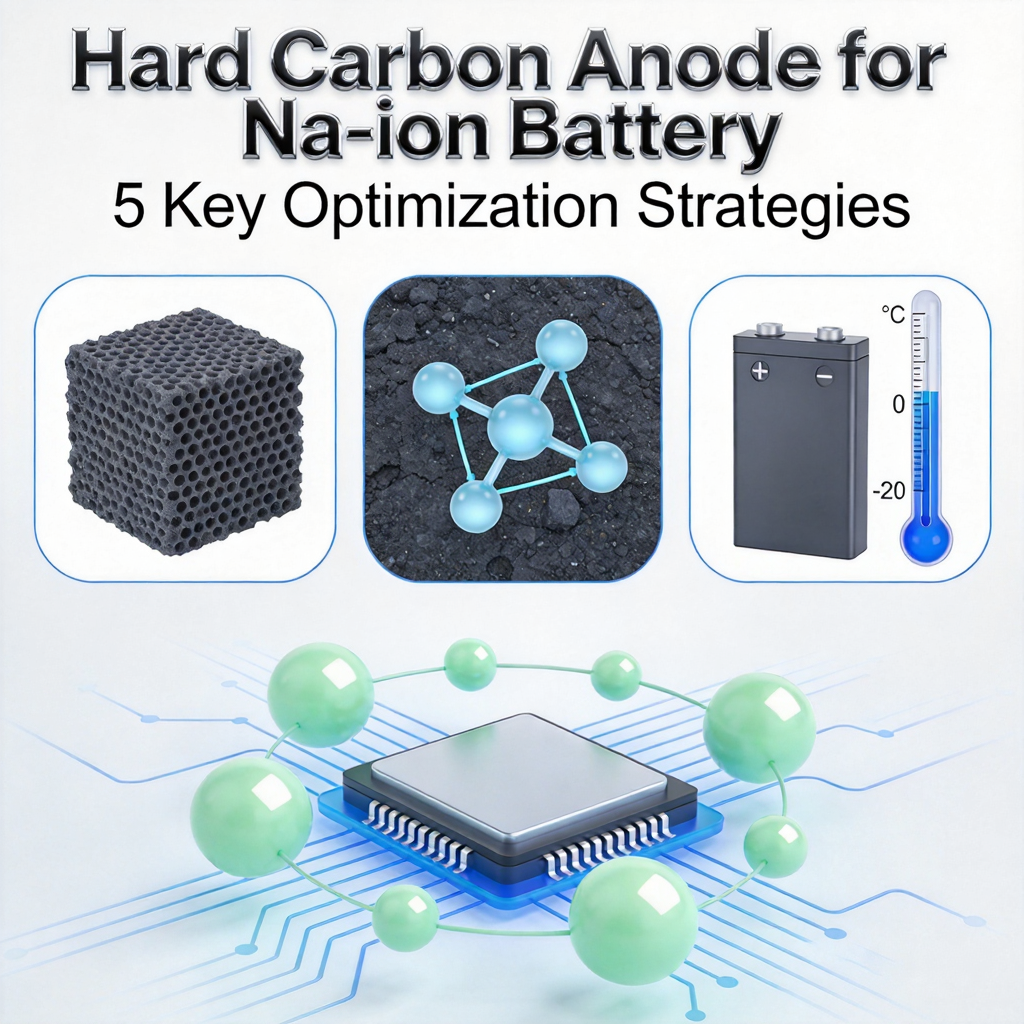
Sodium-ion batteries have emerged as one of the most promising next-generation energy storage technologies, thanks to the abundance and low cost of sodium resources. Hard carbon anodes are key to commercializing sodium-ion batteries, but hard carbon (HC) materials with tunable turbostratic graphite nanodomains and pore structures still face challenges in reversible capacity, rate capability, and low-temperature performance.
This research introduces an in-situ conversion carbonization strategy that addresses these challenges through synergistic optimization of bulk structure and interface environment.
5 Core Challenges in SIB Anode Development
1. Graphite Interlayer Limitation
Unlike lithium-ion batteries where graphite works effectively, the interlayer spacing (3.35 Å) thermodynamically mismatches the Na⁺ ion radius (1.02 Å), preventing effective sodium storage.
2. Irreversible Na⁺ Trapping
Topological defects in hard carbon materials trap Na⁺ ions irreversibly, reducing initial coulombic efficiency (ICE) and energy efficiency.
3. ICE Loss from SEI Formation
While high surface area enhances electrolyte wettability, it also promotes excessive heterogeneous solid electrolyte interface (SEI) growth, causing irreversible capacity loss.
4. Limited Rate Performance
Excessive porosity disrupts graphite domain continuity, hindering electron transport. Na⁺ ions in pores experience strong binding affinity, causing severe rate capability degradation at high current densities (>5C).
5. Low-Temperature Performance Deterioration
At sub-zero temperatures (-20°C and below), Na⁺ desolvation and transport kinetics decrease significantly, leading to severe capacity fade and poor cycling stability.
In-situ Conversion Carbonization: Dual Optimization of Bulk + Interface
This research developed an in-situ conversion carbonization strategy with the following innovations:
Technical Approach:
- Conformal coating of phosphorus-rich polyphosphazene (PZS) on poplar wood (PW) precursor
- Dual-function triethylamine (TEA): promotes polymerization + modifies precursor
- Synthesis of low-concentration N, P co-doped hard carbon (NP-HCs)
Bulk Structure Optimization:
- Rich closed pore structure for enhanced Na⁺ storage
- Expanded interlayer spacing for improved Na⁺ intercalation/deintercalation
Interface Environment Regulation:
- Fast Na⁺ desolvation kinetics
- Optimized ion transport pathways
- Stable low-concentration N/P co-doping reduces surface defect density
Performance Breakthroughs
The NP-HCs material demonstrates exceptional electrochemical performance:
| Performance Metric | Value |
|---|---|
| Reversible Capacity | 428.8 mAh g⁻¹ |
| Initial Coulombic Efficiency | 85.5% |
| High-Rate Capacity (10C) | 272.6 mAh g⁻¹ |
| Low-Temperature Retention (-20°C) | 93.1% |
| Low-Temperature Cycle Life | 1200 cycles |
Key Advantages:
- Ultra-high reversible capacity with excellent ICE
- Outstanding performance retention at 10C high rate
- 93.1% capacity retention under extreme -20°C conditions
- Stable performance after 1200 cycles
Research Significance
Through in-situ/ex-situ characterization combined with theoretical calculations, this research reveals:
- The microscopic nature of Na⁺ storage mechanisms
- Key factors driving accelerated reaction kinetics
- Synergistic effects between bulk structure and interface environment
This work provides important theoretical and experimental insights for designing high-performance hard carbon anode materials, accelerating the commercialization of sodium-ion batteries in energy storage applications.
Contact Us
Need professional sodium-ion battery anode material solutions? Our technical team provides:
- 🔧 Customized sodium-ion battery hard carbon anode development
- 🔧 Sodium-ion battery system design consulting
- 🔧 Low-temperature and rate performance optimization
- 🔧 Full-range energy storage battery product support
📞 Contact Now:Get Technical Support
🌐 Learn More:Cylindrical Lithium Batteries | Energy Storage Solutions