A custom battery pack with a BMS is not just a passive energy store; it is electronic equipment with sensing, protection and often a communication port. That means it can both emit electromagnetic disturbance and have its protection functions disrupted by interference from the equipment around it. For a buyer, the practical answer is to fix the applicable EMC standard by the environment of intended use, define what the BMS must keep doing during and after each immunity test, and require an accredited test report against a defined configuration. The generic references are IEC 61000-6-2:2016 for immunity in industrial environments and IEC 61000-6-4:2018 for emissions in industrial environments, with IEC 60601-1-2 taking precedence for medical electrical equipment. This article explains how those standards fit, what to specify for a BMS-equipped pack, and the evidence to require before design freeze.
Why a BMS-equipped pack is an EMC question at all
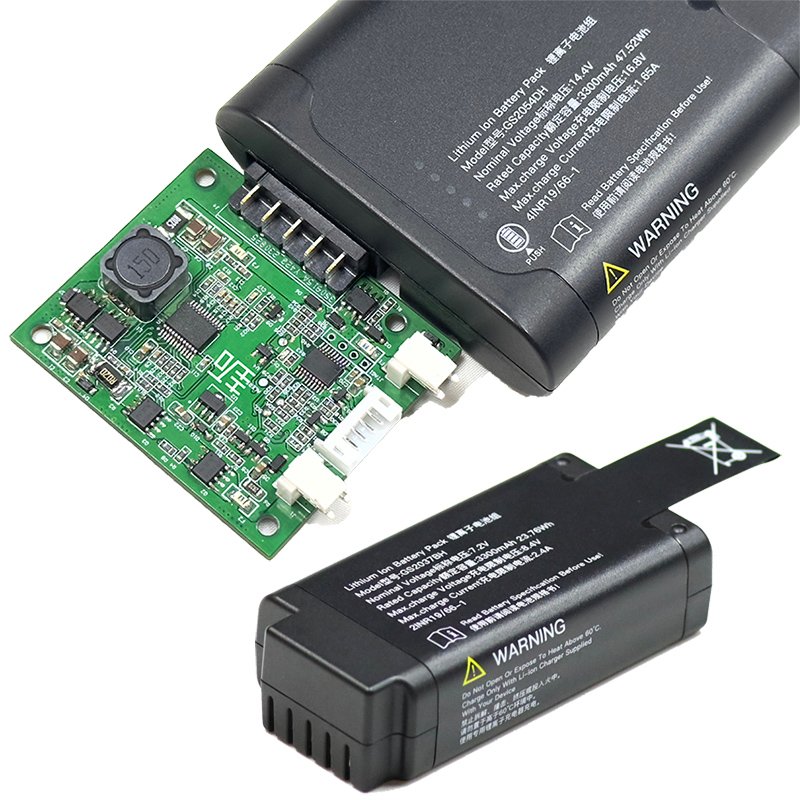
A protection board measures cell voltages and pack current, drives MOSFETs or a contactor, and commonly reports state of charge and fault flags over a wired bus. Each of those functions is susceptible to disturbance, and the switching inside the pack can itself be a source of emissions. Interference that corrupts a voltage reading can produce a false overvoltage trip or, worse, mask a real one. Interference that disrupts the communication link can leave the host without state-of-charge or fault data even though the cells are healthy. Our BMS state of charge accuracy article covers how to specify the sensing accuracy itself; EMC work is about whether that accuracy and the protection decisions built on it hold up when the equipment is exposed to interference.
EMC compliance is normally assessed at the equipment level, not on a loose battery sitting on a bench. A pack integrated into an industrial drive, an AGV, a medical cart or a rack system inherits the EMC obligations of that equipment and its intended environment. That has a direct consequence for procurement: you cannot buy a universally “EMC compliant battery”. You buy a pack whose BMS behaviour has been specified and tested in the configuration and electromagnetic environment in which it will operate. Our BMS communication protocol article describes the data interface that an immunity test needs to monitor.
Which EMC standards apply, and what their published scopes say
The table below uses the published scope wording and edition dates from the IEC webstore pages linked in each row. Note the recurring condition in the generic standards: they apply when no relevant dedicated product or product-family EMC standard exists. For medical equipment, the product-family collateral standard comes first.
| Standard (edition, publication date) | Published scope and coverage | When it applies to a battery system |
|---|---|---|
| IEC 61000-6-2:2016, Ed. 3.0, 2016-08-10 | Generic EMC immunity standard for electrical and electronic equipment intended for use in industrial locations; immunity requirements in the frequency range 0 Hz to 400 GHz are covered; no tests need to be performed at frequencies where no requirements are specified | Immunity reference for a pack installed in an industrial location, where no dedicated product or product-family immunity standard exists |
| IEC 61000-6-4:2018, Ed. 3.0, 2018-02-07 | Generic EMC emission standard for equipment intended for use in industrial locations, indoor and outdoor; emission requirements in the frequency range 9 kHz to 400 GHz; requirements are specified for each port considered | Emission reference in the same industrial environment, and only where no applicable product or product-family emission standard is available |
| IEC 61000-4-2:2008, Ed. 2.0, 2008-12-09 | Basic EMC publication: immunity requirements and test methods for equipment subjected to electrostatic discharge from operators and from personnel to adjacent objects; defines waveform, ranges of test levels, test equipment, setup, procedure, calibration and measurement uncertainty | A test method standard, not an acceptance standard: it explicitly leaves the choice of tests and severity level to the responsible product committee, user or manufacturer |
| IEC 60601-1-2:2014+A1:2020, Ed. 4.1, 2020-09-01 | Collateral standard to IEC 60601-1 for the basic safety and essential performance of medical electrical equipment and systems in the presence of electromagnetic disturbances, and for their emissions; immunity test levels set by environment of intended use (professional healthcare facility, home healthcare, special environments) and by port | The governing EMC reference when the pack is part of medical electrical equipment; our medical device battery pack page covers the wider compliance context |
Two scoping errors follow from misreading that table. The first is treating IEC 61000-4-2 as a pass/fail specification. It is a test method: the standard states that it does not intend to specify the tests to be applied to particular apparatus or systems, and that product committees or users and manufacturers remain responsible for choosing the tests and severity level. So a supplier saying “ESD tested to IEC 61000-4-2” has told you the method but not the level or the criterion. The second is applying a generic industrial standard to medical equipment, where the product-family collateral standard governs and sets immunity levels by the environment of intended use.
Define what the BMS must keep doing during the test
An immunity test is only meaningful once the monitored functions and the acceptance criteria are written down. A pack that keeps its output voltage but silently drops its fault flag to the host during a disturbance has failed a requirement that was never defined. The table below is a template for the functional performance criteria in a pre-compliance test plan; the specific levels and criteria are programme inputs to agree with the compliance lead and the test laboratory, not values supplied here.
| Disturbance to plan for | BMS function to monitor during exposure | Example acceptance criterion to state (agree with your compliance lead) |
|---|---|---|
| Electrostatic discharge, per the IEC 61000-4-2 method | Cell voltage readings, protection trips, state of charge, communication link, fault flags | No unintended charge or discharge MOSFET turn-off; no false overvoltage or overcurrent trip; no loss of protection function; recovery behaviour defined |
| Radiated and conducted radio-frequency disturbance, within the IEC 61000-6-2 immunity framework | Voltage and current measurement accuracy, communication error rate, watchdog and reset behaviour | Measurement error within the agreed band; no spurious fault flags; communication recovers without a manual reset |
| Fast transients and surges on power and signal ports | Contactor or MOSFET state, BMS power supply, bus transceivers | No unsafe state (for example no unintended enabling of charge); no latch-up requiring a power cycle |
| Emissions from the pack’s own switching and clock circuitry, within the IEC 61000-6-4 framework | Emissions measured at each port considered, in the operating mode that produces the highest disturbance | Emissions within the limits of the applicable standard, tested in the worst-case operating mode and cable configuration |
Pay attention to the word “unsafe” in that column. For a BMS, an interference-induced reset that briefly blanks the display is a nuisance; an interference-induced state that disables overcharge protection is a safety issue. The distinction belongs in the acceptance criteria, and it is why EMC acceptance for a BMS-equipped pack should be written with the protection engineer in the room, not left to a generic “no degradation” line. For medical equipment, IEC 60601-1-2 also asks for immunity pass/fail criteria to be identified in the context of basic safety and essential performance, so the criterion is defined before testing, not after a failure.
Build the EMC clause into the specification and the test plan
The requirement is stronger when it fixes the environment, the configuration, the monitored functions and the evidence package. The clauses below are a template for an RFQ or a pre-compliance test plan; the right-hand column lists the evidence to require, not values to copy.
| Clause to specify | Evidence to require | Condition that must be stated |
|---|---|---|
| Environment of intended use | Declaration of the installation environment and the EMC standards selected for it | Industrial location, or professional healthcare facility / home healthcare / special environment for medical equipment; state which generic or product-family standard governs |
| Configuration lock | Bill of materials, BMS hardware and firmware revision, cable and harness layout, enclosure and grounding scheme | The tested sample is production-intent; harness routing and grounding are part of the configuration, since both affect emissions and immunity |
| Functional performance criteria | Test plan listing monitored functions, acceptance criteria for each disturbance, and the worst-case operating mode | Criteria defined before testing; distinction between a nuisance deviation and a loss of protection function |
| Test levels and methods | Report with method standard, applied level, ports tested, and test setup | Level selected per the applicable equipment standard, not just “tested to IEC 61000-4-2” |
| Laboratory and report | Accredited report with report number, date and accreditation scope; ILAC mutual-recognition arrangements support cross-border acceptance of accredited reports | Accreditation for the methods used; report names the configuration and firmware tested |
One sequencing point saves rework: run pre-compliance measurements on a production-intent prototype before booking the formal lab slot. Emissions and immunity outcomes both depend on harness routing, grounding and enclosure seams, so a change made after the formal test can invalidate the result. Our custom smart battery pack with BMS page describes the integration points that need to be fixed in the configuration, and a written RFQ checklist should capture the wider input set a supplier needs.
Questions buyers actually ask
Does a battery pack have its own EMC certificate?
Usually not in the way a buyer expects. EMC compliance is assessed on the equipment in its intended environment. A supplier can provide EMC test evidence for a defined pack configuration, but the acceptance decision belongs to the end equipment. Ask for the report on the defined configuration, then confirm it satisfies the equipment-level standard that governs your product.
Is a CE mark on the pack an EMC test result?
No. A mark is a declaration by the manufacturer that applicable requirements are met. It does not substitute for a test report naming the standards, levels, configuration and criteria. Ask for the underlying evidence, and check that the standard edition and configuration match what you are buying.
What changes force a retest?
Changes to the BMS board, firmware, cell layout, harness routing, enclosure or grounding scheme can all change emissions or immunity behaviour. Treat them as configuration changes that require a documented similarity assessment, and retest where the assessment cannot show equivalence. If you need to map a specific smart pack to an EMC test plan, contact our engineering team.
Kept in scope, EMC work for a BMS-equipped pack is a bounded exercise: fix the environment, fix the configuration, define the functions that must survive disturbance, and require a report that names all three. What it is not is a box to tick from a logo. The distinction matters most for medical and industrial equipment, where a momentary loss of a protection function is a safety question rather than a cosmetic one.