Qualifying a second source for a custom lithium battery pack is not a repeat of the original qualification, and treating it as one wastes either money or risk coverage. Retest everything and you pay twice for a program that already works; retest nothing and the first field failure arrives with your alternate supplier’s label on it. The workable approach separates the requirements that transfer from the requirements that must be re-verified, then sizes a delta-qualification program around what actually changed. This article sets out that split for OEM quality engineers and sourcing managers who need a second pack supplier without doubling the validation budget.

Why battery packs are not commodity parts
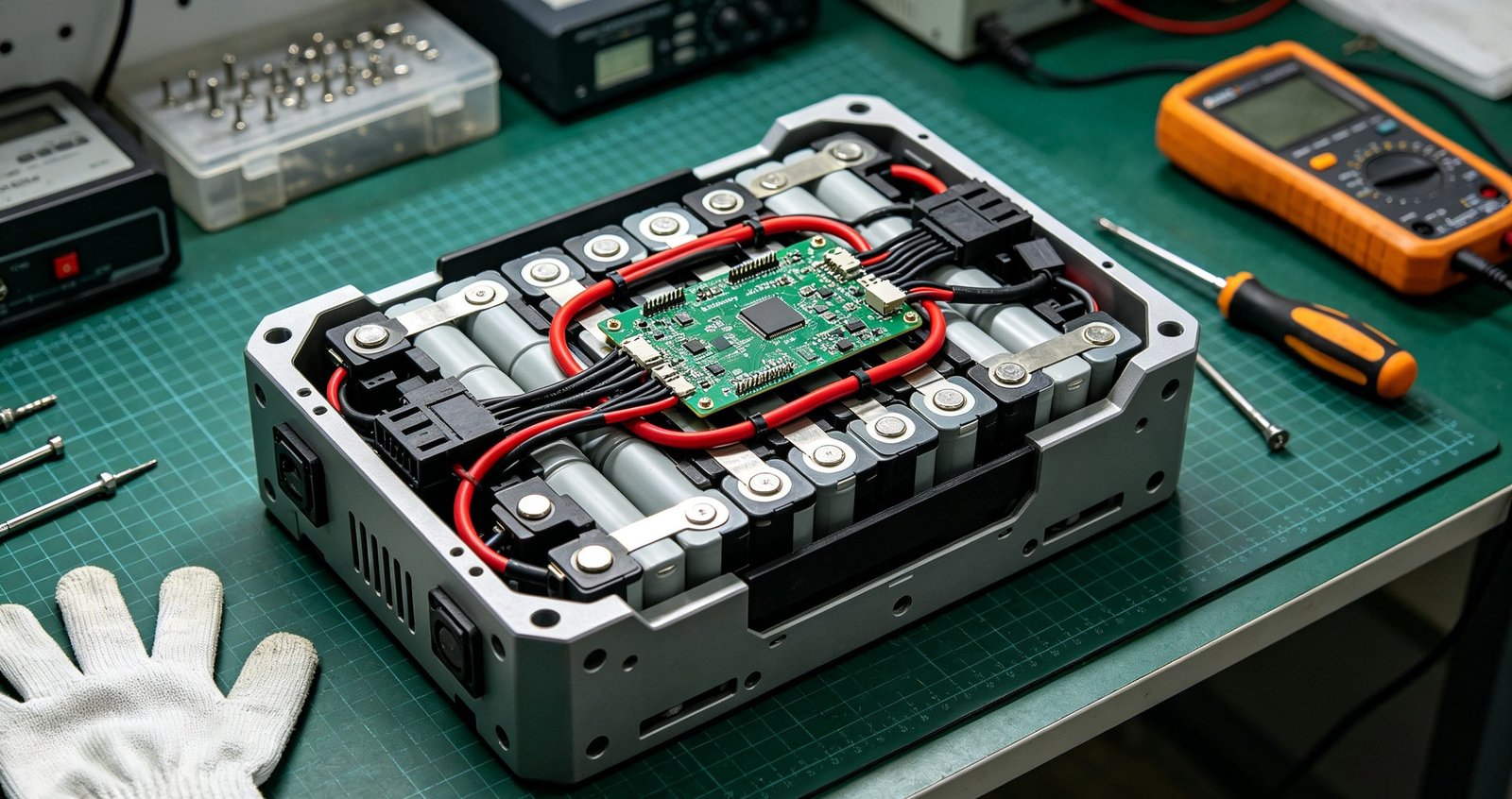
A custom pack is a designed assembly: specific cells, a specific BMS with its own protection thresholds and firmware, a specific nickel or busbar layout, and a specific assembly process. Two suppliers building “the same” 7.4 V 5 Ah pack to the same outline drawing will differ in cell batch, internal resistance distribution, thermal path, weld quality and firmware behavior. Those differences are exactly what qualification exists to expose. They are also why a second source cannot be accepted on a datasheet comparison alone — the role of cell consistency shows how much pack behavior depends on sorting and matching decisions made inside the supplier’s process.
What actually changes with the supplier
Map the change before deciding what to test. Even when the second source proposes the same cell model and the same BMS chip, five things still change: the assembly site, the operators and their training, the welding and joining equipment, the end-of-line test coverage, and the supply chain feeding the line. If the second source proposes different cells or a different BMS, the change set grows to include electrochemical behavior, protection thresholds and host communication. The size of that change set — not company policy — should set the size of the retest program.
What must be retested at the second source
Some evidence cannot transfer, because it is tied to the production site, the design revision or the legal entity that produced it.
| Requirement | Second-source action | Why it cannot carry over |
|---|---|---|
| Safety certification (e.g. IEC 62133-2 or IEC 62619 test reports) | New test report for the second source’s pack design and manufacturing location | Reports are issued against a specific design, site and manufacturer; a certificate is not transferable between factories |
| UN 38.3 transport testing | New test summary for the new pack design | Transport classification applies to the physical article as produced by that manufacturer |
| Capacity, internal resistance and rate performance | Retest per your acceptance plan on production-intent samples | Cell batches and assembly both shift measured performance |
| Protection-function verification | Retest BMS trips: overcharge, over-discharge, overcurrent, short circuit, temperature limits | Firmware parameter sets differ between BMS suppliers even on identical hardware |
| Host-device integration | Verify communication, timing, fuel-gauge accuracy and fault handling in the end device | Protocol edge cases only appear in the actual host |
| Mechanical and environmental fit | First-article dimensional check plus vibration, shock and ingress tests as applicable | Tooling and enclosure tolerances differ between sites |
| Manufacturing quality system | Audit or desk assessment of the new site’s quality system and traceability | Process control is site-specific by definition |
What can carry over — with conditions
Your side of the qualification does not need rebuilding. The device-level requirements, the test methods and acceptance limits you defined for the first source, the test fixtures, and the failure-mode knowledge from the original program all transfer. If the second source commits to the same cell model and the same BMS with the same firmware revision, some pack-level characterization can be reduced in scope — capacity verification on a smaller sample, for example — but the reduction should be a documented decision, not an omission. The economics matter: abuse and performance testing at specialized laboratories is a measurable cost line, and facilities such as Sandia National Laboratories’ energy storage battery testing program illustrate the depth of instrumentation that serious cell and pack characterization involves — depth that a full duplicate program would pay for twice.
Delta qualification: sizing the retest to the change
Delta qualification retests only what the change can plausibly affect, and it needs defined triggers. The table below pairs common second-source changes with the qualification impact they demand.
| Change at the second source | Minimum qualification impact |
|---|---|
| Same cells, same BMS, different assembly site | First-article inspection, lot acceptance sampling, protection-function verification, capacity confirmation |
| Same cell model, different BMS supplier | Full BMS verification plus host integration retest; safety report revision if the BMS is in the certified scope |
| Different cell model, same format and chemistry | Full electrical re-characterization, cycle-life confirmation at the application’s depth of discharge, updated UN 38.3 and safety reports |
| Different chemistry (e.g. NMC to LFP) | Complete re-qualification including charger, BMS thresholds, device low-voltage behavior and transport documents |
| Enclosure, connector or potting change | Mechanical, ingress and vibration retest; EMC re-evaluation if the change affects shielding or cabling |
| Firmware update on an unchanged design | Regression test on protection functions and host communication; document the parameter diff |
Standards bodies have made part of this mapping easier by scoping their documents by application. IEC 62619:2022 covers lithium cells and batteries for industrial applications — stationary systems and motive uses such as automated guided vehicles — and includes requirements for evaluating the battery and BMS combination, which is precisely the interface that changes when the BMS supplier changes. National standards databases such as the Canadian NRC standards reference for energy storage safety let you confirm which safety standard (UL 1642, UL 1973, IEC 62619) applies to your product category before you write the retest scope.
Three findings that recur in second-source programs
Programs that have run this process more than once tend to hit the same three findings, and knowing them in advance changes how you scope the audit. First, traceability gaps: the second source can build good packs but cannot tell you which cell lot went into which pack serial number, which blocks any field-return analysis you might need later. Traceability is a system feature — it either exists on the line or it does not, and it cannot be added retroactively for units already shipped. Second, threshold drift: the second source’s default BMS parameters are almost never identical to the first source’s, and differences of a few hundred millivolts in overcharge cut-off or a few amps in overcurrent trip look harmless until a device-side edge case — a fast load transient, a cold boot — behaves differently across the two sources. Fixing this is a paperwork exercise: demand the parameter sheet as a controlled document and diff it against your specification, lot by lot at the start. Third, connector and tooling reality: outline drawings match, but connector mating force, keying orientation and latch behavior differ enough to matter on an assembly line built around the first source. A first-article inspection that includes mating-cycle checks on the actual vehicle interface catches this before production does.
The documentation package to require from the second source
Before pilot units ship, the second source should deliver a defined package. Every document in it is checkable — and checking is where most second-source programs either earn confidence or stop.
| Document | What to verify | Red flag |
|---|---|---|
| Quality management certificate (ISO 9001 or equivalent) | Issuer is an accredited certification body; certificate is current and covers the manufacturing site | Certificate from an unaudited or non-accredited issuer, or site name that does not match the quote |
| Safety test report | Report lists the exact pack design, revision and manufacturer; tests performed at an accredited laboratory | Report for a “similar” design, or a report that predates the current BMS firmware |
| Cell sourcing declaration | Named cell manufacturer, model, and traceability to lot codes | Unbranded cells or refusal to disclose origin |
| First-article inspection report | Dimensional and electrical results against your drawing, with measurement data | Pass/fail with no measurements |
| BMS parameter sheet | Protection thresholds and hysteresis values against your specification | Thresholds “per supplier standard” with no numbers |
Certificates deserve one extra step: validation in a public database. The International Accreditation Forum operates IAF CertSearch, where certificates issued by accredited bodies can be checked for status and scope. A certificate that cannot be validated there — or that lists a different legal entity than the one shipping your packs — is a finding, not a formality.
Pilot lot, then production
Run the delta-qualification program on production-intent pilot units from the second source’s actual line, not on hand-built samples. Then hold the line to the same lot-acceptance discipline you apply to the first source. Your incoming inspection plan — the acceptance tests and sampling logic described in our battery pack incoming inspection guide — should treat the second source as a new supplier for a defined number of lots, with tightened sampling that relaxes only as data accumulates. Track the two sources’ lot data side by side: capacity distribution, internal resistance spread and protection-trip margins are the early indicators of a process difference that will become a field problem later.
Cost and timeline realism
Three cost drivers dominate a second-source program: laboratory retesting (safety and transport reports are priced per design and per site), engineering time for host-integration retest, and the pilot lot itself. Timeline is usually governed by the safety report cycle rather than by production — a pack that needs a fresh IEC 62133-2 or IEC 62619 report carries the laboratory’s queue time, not the factory’s build time. Programs that plan around that fact sequence the paperwork in parallel with the pilot build instead of after it.
A pragmatic qualification sequence
In practice, the sequence that works: audit the quality system first, because a weak system invalidates everything downstream; lock the change map second, so the retest scope is a consequence of documented deltas, not negotiation; run delta qualification on production-intent units third; and keep both sources active afterward — a second source that never ships a production lot quietly de-qualifies itself as its process drifts. Suppliers set up for this workflow, like our custom lithium battery pack manufacturing operation and our turnkey battery pack programs, publish their quality documentation and test coverage up front, which shortens the audit stage considerably. To discuss a specific change map for a pack you need to dual-source, use the contact page and include the current pack’s specification — the first deliverable we return is the delta-qualification scope itself.