
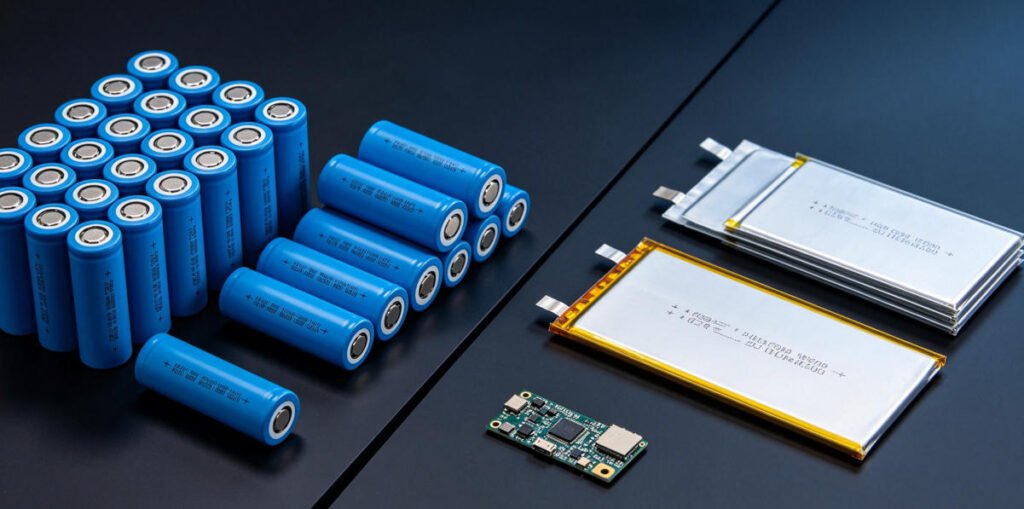
Li‑ion vs Li‑polymer battery is one of the most frequent comparison questions for battery distributors, equipment integrators and industrial product designers. Both belong to lithium‑ion chemistry family, share similar nominal voltage, and power countless portable devices. However, critical gaps in structure, mechanical performance, cost and service life often lead to wrong component selection during bulk sourcing, resulting in extra project costs, unexpected swelling issues or field‑side safety risks. This guide breaks down core distinctions, practical trade‑offs and real‑world application recommendations for business buyers.
At the core, the biggest difference lies in electrolyte and packaging. Lithium‑ion (Li‑ion) cells adopt liquid electrolyte sealed inside rigid metal casing, available in cylindrical or prismatic formats. Lithium‑polymer (Li‑Po) cells use gel‑polymer electrolyte housed within soft laminated pouch foil, removing hard metal shell constraints. This fundamental structural variation shapes nearly all real‑world behaviors when evaluating li‑ion vs li‑polymer battery for your product design.
Li‑ion vs Li‑polymer Battery: Core Technical Comparison for Bulk Buyers
| Parameter | Lithium‑ion (Li‑ion) | Lithium‑polymer (Li‑Po) |
|---|---|---|
| Packaging | Rigid metal casing, cylindrical / prismatic | Soft laminated pouch, flexible shape |
| Shape flexibility | Limited to standard fixed sizes | Highly customizable for slim, irregular housing |
| Typical cycle life | 500‑1500 cycles | 300‑1000 cycles |
| Relative cost | Lower, mature mass production | 15‑25 % higher, custom design adds NRE cost |
| Weight | Standard weight | Around 20 % lighter for equal capacity |
| Mechanical safety feature | Built‑in safety vent, CID / PTC protection | Relies fully on external BMS; vulnerable to puncture and swelling |
| Common compliance | IEC 62133, IEC 62619, UN38.3 | IEC 62133, UN38.3; pouch integrity focused testing |
Key Strengths When You Pick Li‑ion in li‑ion vs li‑polymer battery Evaluation
Stable mechanical structure is the biggest strength for li‑ion cells. The metal shell offers physical protection against minor squeezing and impact, which reduces field failure risk for fleet‑level deployments.
Cost‑effective mass procurement makes li‑ion the default choice for high‑volume projects. Standard cell formats such as 18650 and 21700 are widely stocked across global suppliers, with stable lead‑time and competitive unit price. You can read more about common standard cell specifications in our article about 18650 vs 21700 battery.
Longer consistent cycle performance helps lower total ownership cost. For devices requiring repeated charge‑discharge over years, li‑ion usually delivers more predictable capacity retention than comparable li‑polymer options.
Typical suitable scenarios: portable power stations, industrial sensors, power tools, medical equipment with standard housing, and large‑volume consumer electronics.
Key Strengths When You Pick Li‑Po in li‑ion vs li‑polymer battery Evaluation
Ultra‑high form factor flexibility is where li‑polymer outperforms. Engineers can design ultra‑thin, curved or irregular‑shaped battery packs to make full use of leftover internal device space, without being limited by standard cell dimensions.
Lightweight performance benefits weight‑sensitive hardware. For UAV, FPV racing drones and wearable devices, reduced battery weight directly improves runtime and equipment maneuverability. Further practical guidance can be found in our drone battery buying guide.
High‑discharge li‑polymer variants can deliver strong instantaneous current output, widely adopted in drone and RC hobby applications.
Typical suitable scenarios: custom slim wearable devices, FPV drones, compact medical handheld hardware, special‑shape IoT equipment. If you plan to build non‑standard packs, check our resource for custom lithium‑ion battery pack development.
Common Sourcing Mistakes to Avoid
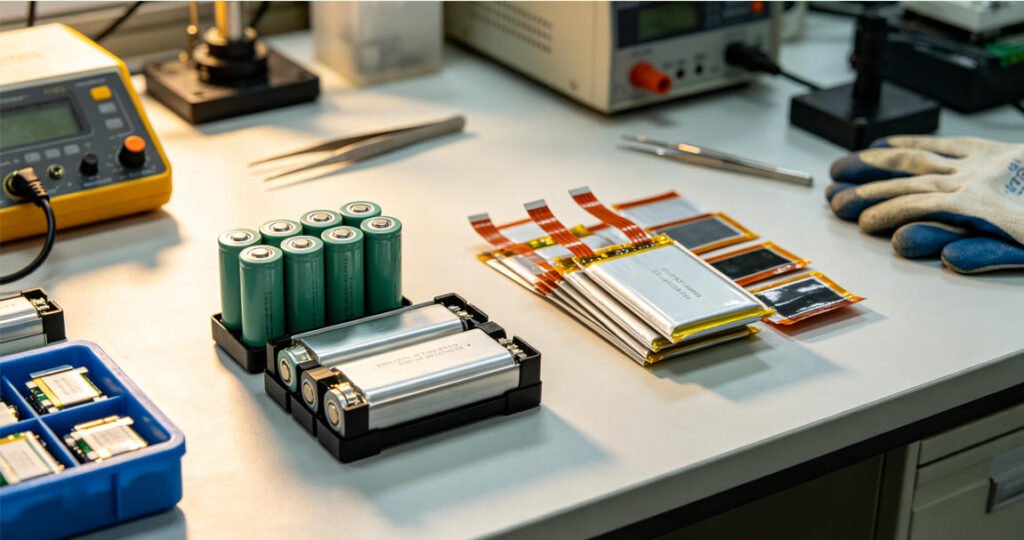
Many buyers assume li‑polymer always equals safer battery solution. This is misleading. Soft pouch cells have no rigid shell; once over‑charged, over‑discharged or physically damaged, battery swelling becomes a major hidden risk. Reliable BMS protection is non‑negotiable for every li‑polymer pack you source.
Another frequent error: choosing li‑polymer for large‑volume orders only chasing lightweight gain. You need to evaluate higher unit price plus custom tooling NRE cost. If your product accepts standard cell dimensions, li‑ion will normally bring better overall economics.
Always verify compliance documents before placing mass orders. Both battery types must pass UN38.3 transportation certification. For industrial applications, reference IEC 62619 requirements for safety assessment. You can review detailed safety research resources from Battery University and official IEC standard documents.
Quick Decision Checklist for Your Project
- Pick li‑ion battery, if your priorities are: mass‑volume cost control, long cycle stability, anti‑impact mechanical reliability, standard housing dimension.
- Pick li‑polymer battery, if your priorities are: ultra‑thin or custom irregular shape, strict weight reduction requirement, drone / high‑thrust RC equipment.
Neither li‑ion nor li‑polymer is universally better in the li‑ion vs li‑polymer battery comparison. Correct selection depends on your product mechanical constraints, target cost budget, expected service life and operating environment.
If you are evaluating custom battery pack solutions for your project, contact us to obtain datasheet support and technical consultation.