
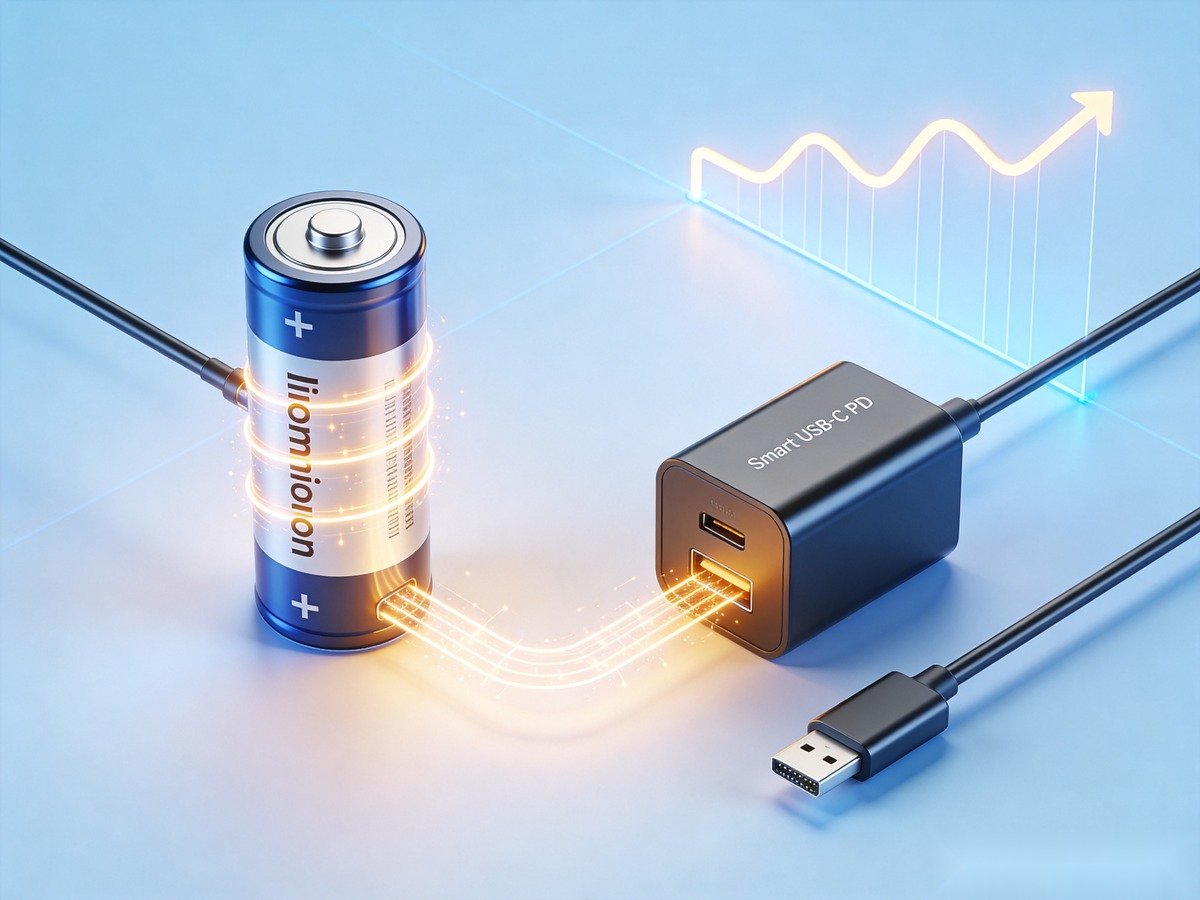
Ultra Fast Charging Industrial Power Module for Wide Temperature Industrial Applications
Two specs decide whether an industrial power module earns its place on a buyer’s shortlist: how fast it recovers from a depleted state, and how reliably it does so when the thermometer reads –40 °C in a Siberian truck yard or +70 °C inside a parked solar cabinet. Ultra-fast charging solves the first. Wide-temperature-range operation solves the second. A module that ships without both is a liability the moment it leaves the warehouse.
This guide is for industrial buyers and OEM/ODM procurement teams who evaluate fast charging technology and wide temperature range technology as a single combined specification. Focus: the 100–240 W class, the –40 °C to +85 °C operating envelope, and the certifications B2B buyers actually ask for — CE, FCC, UL, RoHS, REACH, UN38.3.
What Defines an Ultra Fast Charging Industrial Power Module
Ultra-fast charging is the high end of fast charging: 100 W and above, up to the 240 W ceiling of USB Power Delivery 3.1 Extended Power Range (EPR). It is the tier to target when downtime translates directly into lost revenue — AGV fleets, mobile medical carts, drone battery hubs, field-service vehicles.
Wide temperature range technology is the set of design choices — component selection, thermal management, enclosure sealing, battery chemistry, firmware protection curves — that let a module operate continuously across an industrial ambient envelope. The baseline is –40 °C to +85 °C operating, –40 °C to +125 °C storage. Consumer-grade products usually fail outside 0–45 °C, which is why a 100 W-rated charger still disappoints in the field.
Treat the two as a coupled pair. A 240 W ultra-fast module that throttles to 15 W the moment the cabinet climbs past 55 °C is functionally a 15 W product for most of the day. The datasheet headline is correct. The deployment reality is not. Specifying the combined capability is how professional procurement closes that gap.
The protocols that matter
- USB PD 3.1 + EPR. Current mainstream. Programmable Power Supply (PPS) adds 20 mV steps so the charger matches the battery’s real-time absorption curve. EPR raises the ceiling to 240 W at 28 V / 36 V / 48 V. Industrial modules in 2026 should be PD 3.1-compliant, not PD 3.0.
- Qualcomm Quick Charge 5. Still common in legacy Android industrial handhelds. QC 5 supports 100 W+ and is backward compatible to QC 2.0. If your fleet includes older devices, dual-stack PD + QC is non-negotiable.
- Proprietary protocols. Huawei SuperCharge, Oppo SuperVOOC, Xiaomi HyperCharge, Samsung Super Fast Charging 2.0 push 120–200 W but lock you to a single vendor. For mixed fleets, vendor-locked protocols are a procurement risk, not a feature.
Three numbers decide whether a charger is genuinely “ultra-fast”: power density (1.5–2.5 W/cm³ for a quality GaN design — 1.7–2.5× silicon MOSFET), conversion efficiency (92–96% at 50% load for GaN), and thermal headroom (the gap between rated max and throttle temperature).
Why Wide Temperature Range Technology Is Critical
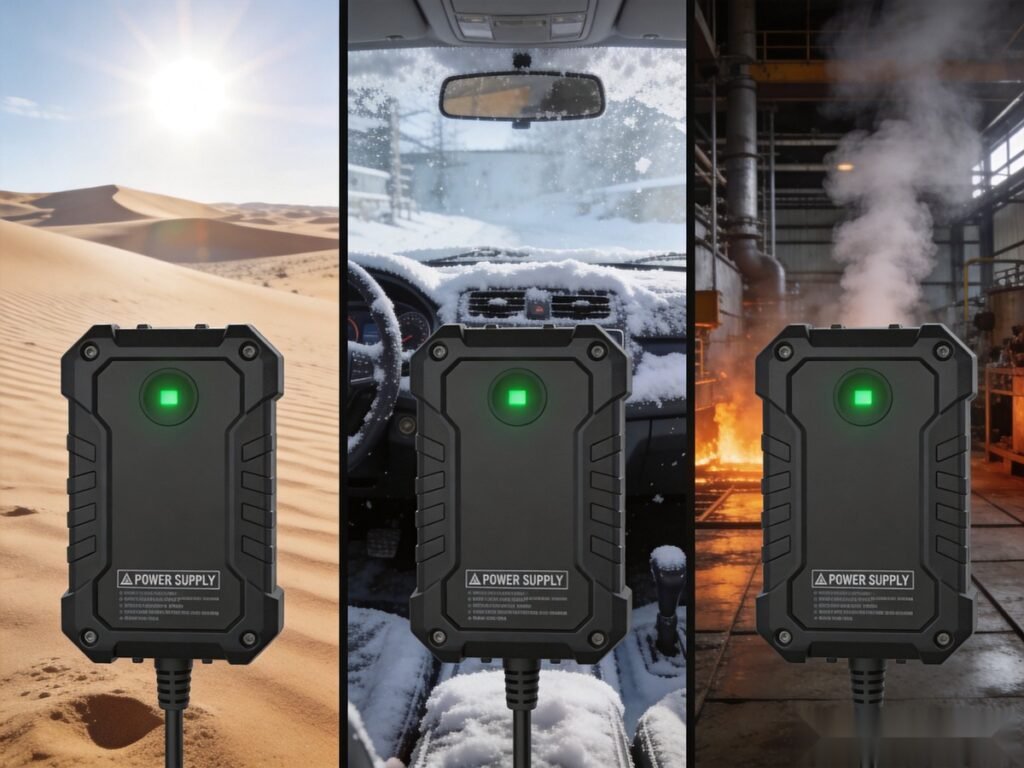
Industrial deployments do not live in climate-controlled offices:
- Outdoor telecom and surveillance cabinets — –40 °C to +70 °C ambient, with solar gain pushing internal temperature 15–25 °C above ambient.
- Energy storage systems (ESS) — LiFePO4 cells charge only above 0 °C. A wide-temperature charger with low-temperature preheat and high-temperature current foldback is what makes a –20 °C winter charge possible.
- Vehicle-mounted and fleet applications — Forklifts, AGVs, last-mile EVs, field-service vehicles see –35 °C (overnight in northern winters) to +80 °C (afternoon sun on a black dashboard). Engine-bay modules face 105 °C+ peaks.
- IoT gateways and remote monitoring — Often fully exposed, sometimes solar + battery. Low-temperature charging efficiency and high-temperature survivability define MTBF.
The cost of ignoring the envelope: lithium plating below 0 °C (permanent capacity loss), accelerated calendar aging above 45 °C (cycle life can halve), and electrolytic capacitor failure (the most common field-failure mode, almost always driven by sustained operation near 105 °C).
B2B Selection Guide: 6 Things to Check
- Certifications and compliance. Confirm CE, FCC, UL/cUL, RoHS, REACH, and (for any lithium product) UN38.3 + IEC 62133. For automotive add E-Mark or ISO 7637-2. A supplier without test reports dated within the last 24 months is a risk, not a supplier.
- Real operating temperature, not storage. Ask for the derating curve, not the headline range. A module rated –40 °C to +85 °C that throttles to 30% power above 60 °C is a different product from one that holds 100% to 75 °C.
- Combined spec, not separate specs. Ask for a single datasheet row showing full-power output across the full temperature range. If they cannot produce it, the combined capability was never tested.
- Protocol stack transparency. Which PD revision, which PPS voltage window, which QC version. The negotiation must surface as a visible status output (LED, OLED, MODBUS, or CAN bus) so an integrator can log it.
- MTBF and field data. Target ≥ 100,000 h per MIL-HDBK-217F or Telcordia SR-332. Ask for field-failure data from named customers in named industries, not testimonials.
- Thermal management details. Industrial-grade ceramic and polymer capacitors in hot zones (no aluminum electrolytics near heat sources), IP54 minimum indoor-outdoor crossover, IP67 for fully outdoor, and firmware foldback with hysteresis to prevent oscillation.

FAQ
What is the difference between fast charging and ultra-fast charging?
Fast charging covers 65 W (USB PD 3.1 PPS) upward. Ultra-fast charging is the high end — 100 W and above, up to the 240 W USB PD 3.1 EPR ceiling. In industrial contexts, ultra-fast is the tier that meets shift-pattern downtime, where charging windows are 30 minutes or less.
Why can’t I use a consumer-grade fast charger in industrial deployments?
Consumer-grade chargers are typically rated for 0–45 °C and lack the component selection, sealing, and firmware foldback needed for industrial environments. Their failure modes — lithium plating, capacitor failure, accelerated aging — are silent and irreversible until the battery is already damaged.
Do ultra-fast charging and wide-temperature operation conflict?
No. They are synergistic. A module with both is a different product category from one with either alone. Specify them together, test them together, and reject vendors who cannot show combined test data.
Talk to a Specialist
Need a module that hits the combined spec? Send your temperature envelope, peak power target, and protocol stack to a specialist on WhatsApp: +86-15112443431. We will match the datasheet to your deployment, not the other way around.