
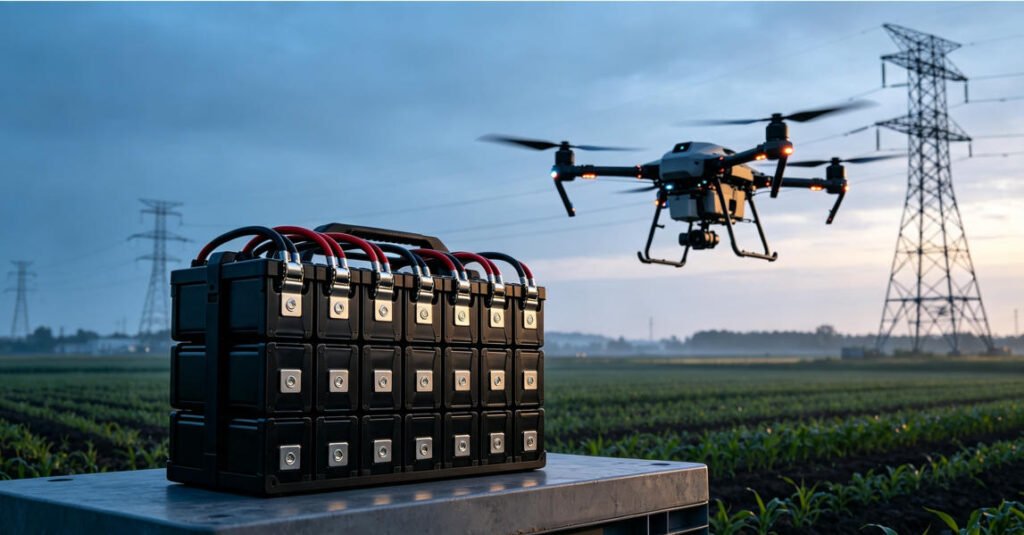
Drone Battery 2026 cost‑saving selection is the core priority for all industrial UAV OEM bulk buyers. When sourcing durable, safe drone battery for industrial unmanned aerial vehicles, OEM manufacturers, fleet operators and agriculture service providers face universal pain points: short flight time, unstable power output in extreme weather, short cycle life and hidden safety risks. Choosing matched drone battery directly boosts flight duration and cuts long‑term fleet operating cost.
This full buying guide combines 2026 low‑altitude economy market data, IEC international safety standards and lab test results from Battery University, sorting out 7 core cost‑saving selection rules for mapping, power inspection, crop spraying and cargo delivery UAV buyers.
For the Drone Battery 2026 industry landscape, the global industrial UAV battery market scale will reach $22.1 billion, with industrial drone equipment demand accounting for 62.1% of total consumption. Semi‑solid lithium drone battery gradually replaces traditional high‑rate LiPo packs and becomes the mainstream technical route for medium and large UAVs, thanks to higher energy density and better thermal stability.
1. Drone Battery Discharge C‑Rate Matching For Different UAV Mission Loads
Discharge rate is the top core indicator of drone battery, which decides power stability during takeoff, heavy-lift climbing and high-speed flight. Many buyers pick low C-rate drone battery and face voltage collapse mid-air, leading to forced return.
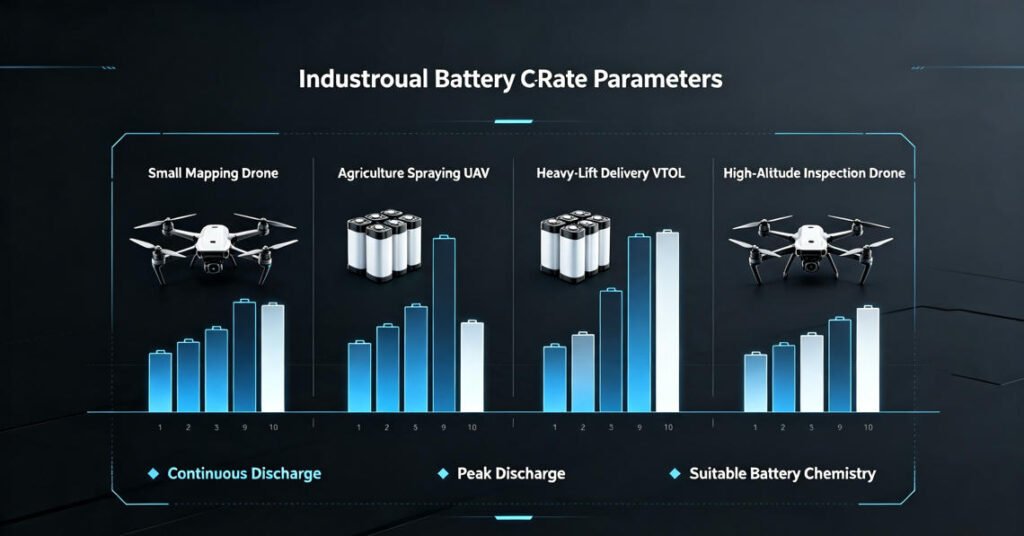
Standard C-Rate Matching Table For Different Industrial Drones
| UAV Type | Required Continuous Discharge | Peak Discharge | Suitable Drone Battery Chemistry |
|---|---|---|---|
| Small Mapping Drone | 3C–5C | 6C–8C | Standard high-rate LiPo |
| Agriculture Spraying UAV | 5C–8C | 10C–15C | Thick electrode LiPo / Semi-solid |
| Heavy-Lift Delivery VTOL | 8C–12C | 15C–20C | High-power semi-solid lithium |
| High-Altitude Inspection Drone | 4C–6C | 7C–10C | Wide-temperature semi-solid cell |
Lab tests published on Battery University prove that an insufficient peak discharge drone battery will cause a sharp voltage drop under full payload, shortening safe flight distance by over 30%. For OEM bulk orders, confirm continuous and peak C-rate with battery manufacturers according to maximum takeoff weight.
2. Drone Battery Wide‑Temperature Adaptability For All‑Weather Missions
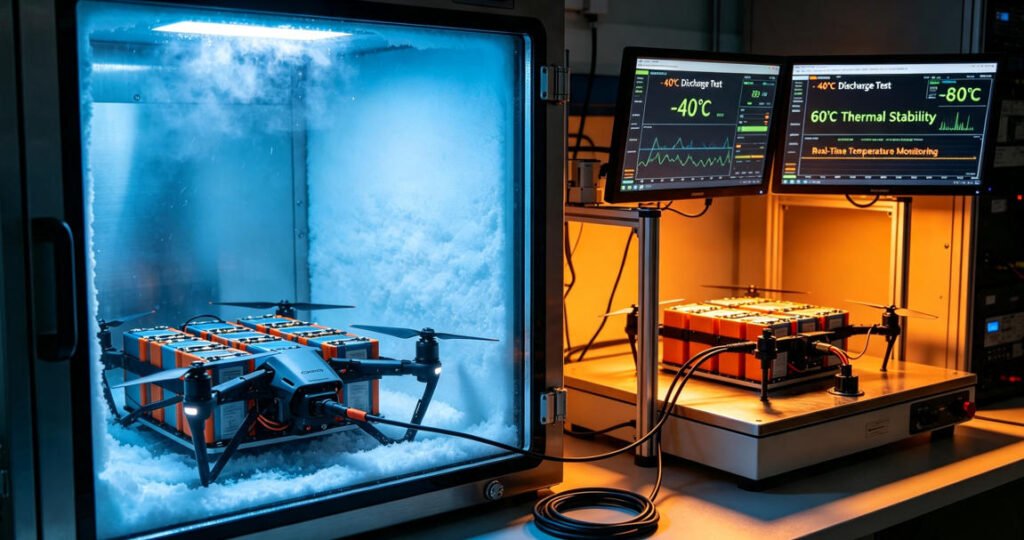
Most traditional drone battery fails to discharge normally below -10℃ or above 50℃, limiting operation seasons for agriculture and mountain inspection fleets. 2026 mainstream industrial drone battery adopts optimized low-temperature electrolyte, supporting stable output from -40℃ to +60℃.
Key advantages of wide-temperature drone battery:
- No sharp capacity attenuation under -30℃ plateau flight
- Suppress thermal expansion in high-temperature summer operation
- Reduce extra heating module cost for cold-region UAVs
When comparing drone battery suppliers, ask for low-temperature discharge test reports compliant with IEC 62619 standard to avoid seasonal mission interruptions.
3. Lithium Chemistry: LiPo VS Semi-Solid Drone Battery Comparison
Two mainstream drone battery technical routes dominate the 2026 market, each matching distinct UAV application scenarios.
Core Performance Contrast
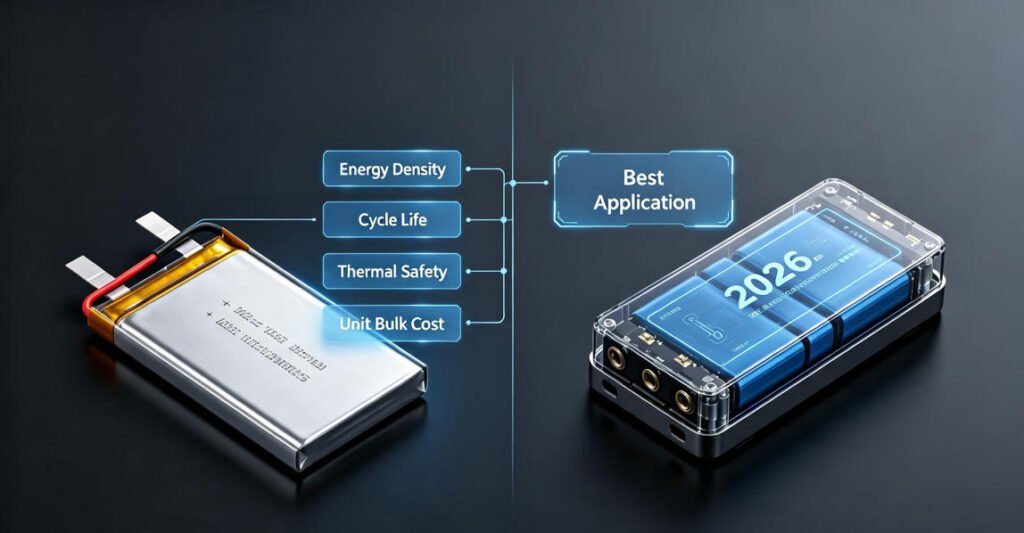
| Index | Traditional High-Rate LiPo Drone Battery | 2026 Semi-Solid Drone Battery |
|---|---|---|
| Energy Density | 180–220 Wh/kg | 300–350 Wh/kg |
| Cycle Life (80% capacity retention) | 300–500 cycles | 500–1200 cycles |
| Thermal Safety | Medium, easy bulging under overload | High, less lithium dendrite risk |
| Unit Bulk Cost (2026) | Low entry price | Higher single cell, lower TCO |
| Best Application | Small consumer & light mapping UAV | Heavy-lift, long-endurance industrial drone |
For long-term fleet operation, semi-solid drone battery cuts annual battery replacement frequency by half, greatly reducing total procurement expense despite higher initial cost. Battery University long-cycle testing verifies semi-solid packs have 2x longer service life than ordinary LiPo drone battery.
4. Energy Density & Flight Endurance Optimization
Energy density directly determines how long a drone battery can support single flight without increasing airframe weight. 2026 new semi-solid drone battery breaks the 300Wh/kg threshold, extending single mission time by 20%–40% compared with 2024 common lithium packs.
Sourcing tips for drone battery capacity matching:
- Fixed-weight UAV platforms prioritize high energy density semi-solid drone battery to extend working hours;
- Light mini mapping drones can adopt cost-effective high-rate LiPo drone battery;
- Avoid blindly stacking large-capacity drone battery, excessive weight will reduce payload and power consumption efficiency.
5. Complete International Safety Certifications
Cross-border OEM export drone battery must pass unified global standards, uncertified packs will be detained at customs and trigger flight safety hazards. Qualified industrial drone battery needs full documents:
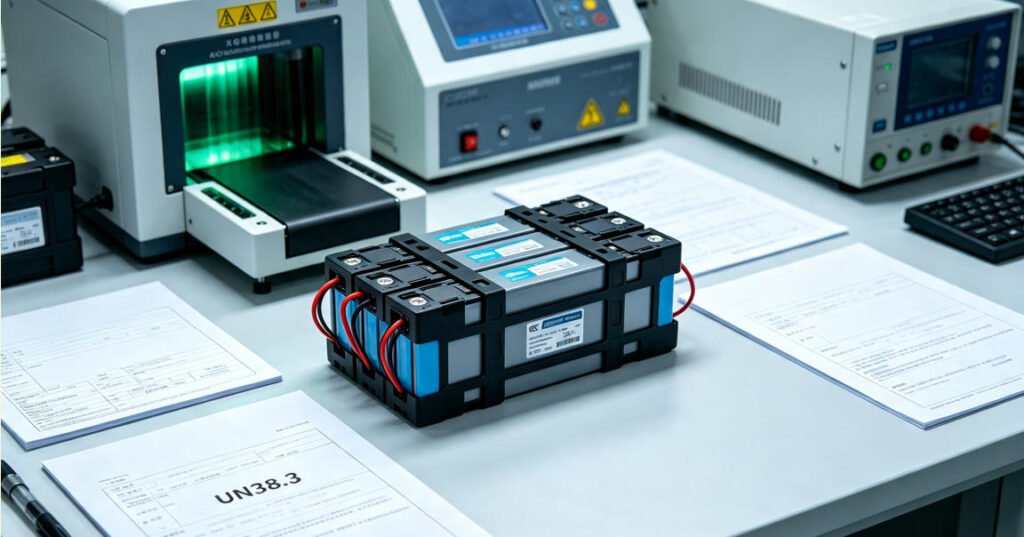
- UN38.3 lithium cell transportation certification
- IEC 62619 secondary lithium battery safety standard
- UL2272 battery pack system certification
- RoHS & CE for consumer/industrial electronic compliance
When evaluating drone battery manufacturers, request full certification test reports for bulk orders, especially for EU, US and Southeast Asian UAV export projects.
6. BMS Intelligent Management For UAV Flight Control
High-quality industrial drone battery equips customized intelligent BMS, realizing real-time monitoring of voltage, current, temperature and SOC data, which can synchronize data with UAV flight control system.
Core BMS functions of premium drone battery:
- Single cell voltage balance to eliminate short-board capacity loss
- Overcharge, over-discharge, over-current and over-temperature automatic protection
- Real-time data transmission to ground control station for risk early warning
- Low-temperature preheating logic for cold-area missions
Ordinary low-cost drone battery uses simplified passive BMS, easily causing single cell over-damage and sudden power loss during long-distance flight.
7. OEM Customization & 2026 Supply Chain Trends
2026 drone battery supply chain shows clear differentiation: small batch UAV modification clients demand flexible MOQ, while large industrial drone brands require mass stable delivery. Reliable drone battery manufacturers support full customization:
- Custom voltage strings: 6S / 12S / 14S / 24S drone battery packs
- Adjust size, shape to fit exclusive UAV battery bay
- Custom BMS communication protocol matching self-developed flight controller
- Custom labeling, packaging for brand OEM export
2026 market trend: Chinese drone battery factories occupy 68% global production capacity, with stable raw material supply and competitive customized service compared with overseas suppliers. For global UAV OEM buyers, cooperating with domestic professional drone battery manufacturers can shorten lead time and cut overall procurement cost.
Conclusion: How To Pick Suitable Drone Battery In 2026
There is no universal best drone battery for all industrial UAVs. Match core parameters according to your aircraft’s payload, operating environment, flight duration requirement and export market certification rules:
- Light mapping small UAV: Cost-effective high-rate LiPo drone battery;
- Agriculture spraying & heavy-lift delivery VTOL: High C-rate semi-solid drone battery;
- High-altitude, cold-region all-weather inspection UAV: Wide-temperature certified semi-solid drone battery with full IEC & UN38.3 certificates.
HR Battery provides custom industrial drone lithium battery packs for agriculture, power inspection, logistics delivery and surveying UAV OEM brands. Contact our technical team to get tailored drone battery quotation and parameter matching scheme for your UAV project.
FAQ:What should OEM buyers look for when comparing Drone Battery 2026 options?
- What’s the difference between LiPo and semi-solid drone battery in 2026?
Semi-solid drone battery has higher energy density, longer cycle life and better thermal safety, while LiPo drone battery owns lower initial cost for light small UAVs. - What certifications do export drone battery need?
UN38.3 transport test, IEC 62619 safety standard, UL2272 and CE/RoHS complete documents are mandatory for cross-border UAV sales. - How to extend drone battery flight time?
Choose high energy density semi-solid drone battery, match correct discharge C-rate and optimize UAV load weight to reduce power consumption. - Can HR Battery customize special-size drone battery for exclusive UAV models?
Yes, we support full OEM customization of voltage, capacity, dimension and BMS communication with flexible small MOQ for industrial drone manufacturers. - What temperature range can 2026 industrial drone battery work stably?
Our wide-temperature drone battery maintains stable discharge performance from -40℃ to +60℃, suitable for plateau, polar and high-temperature tropical mission environments.