
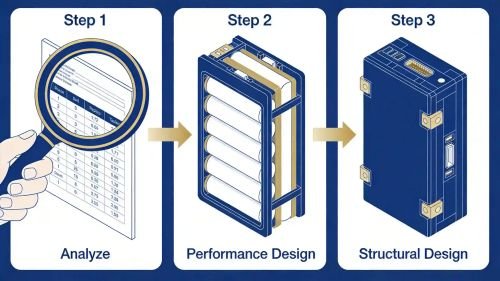
Battery design is the cornerstone of lithium battery R&D and manufacturing, directly determining the safety, reliability, and service life of the final product. Whether for consumer electronics or custom battery design for medical devices, a well-defined battery design process is essential for ensuring product quality. This article introduces a systematic 3-step approach to battery design, guiding you through the complete workflow from performance specification analysis to structural finalization.
Step 1: Comprehensively Analyze Technical Indicators and Identify Key Challenges
The first step in battery design is to thoroughly review and analyze the technical specifications provided by the equipment manufacturer, identifying the most critical design challenges. Typically, these specifications include working voltage, voltage accuracy, operating current, operating time, mechanical load, service life, and ambient temperature. Among these, working voltage (and voltage accuracy), capacity, and service life are the three most crucial parameters.
Working voltage determines the direction of battery chemistry selection, while voltage accuracy impacts power supply stability. Capacity directly affects the runtime of the device. Life design relates to the total cost of ownership and long-term reliability. In a practical lithium battery design process, engineers must balance the trade-offs among these indicators—for example, pursuing higher capacity may compromise cycle life, while demanding environmental temperature requirements impose stricter standards on electrolyte and separator selection.
Step 2: Performance Design — Defining Core Parameters and Material Selection
Once key challenges are identified, the process moves into battery performance design. The core tasks include:
- Operating Current Density: Determining an appropriate current density based on the key challenges. Excessively high current density accelerates polarization and shortens life, while overly low density fails to meet power requirements.
- Process Type Selection: Different manufacturing processes (e.g., winding vs. stacking) significantly impact battery performance and must be chosen according to the application scenario.
- Voltage and Performance Design: Precisely designing key performance parameters such as voltage plateau and discharge curves based on the selected process.
- Design Capacity and Active Material Ratio: Based on the actual required capacity, determine a reasonable design capacity margin and calculate the proportional amounts of cathode and anode active materials.
- Separator and Shell Material Selection: Separator materials affect ion conduction and safety, while shell materials relate to mechanical strength and sealing performance. Their proper combination is critical for life design.
Performance design is the most technically demanding phase of the entire lithium battery design process. Even minor adjustments to individual parameters can have far-reaching effects on the final product performance.
Step 3: Structural Design — Comprehensive Finalization from Cell to Pack
After performance parameters are established, the process enters the battery structural design phase. This phase covers both individual cells and battery packs:
Individual Cell Structural Design
Cell structural design includes determining external dimensions, designing the cell housing, formulating electrolyte composition and fill volume, specifying separator dimensions and assembly methods, and designing conductive networks, terminals, and vent holes. Every detail must balance performance requirements with manufacturing feasibility.
Battery Pack Structural Design
For battery packs, additional design work is required for cell arrangement and combination, pack enclosure structure, insulation and cushioning materials, and thermal management systems. Particularly in high-reliability applications such as medical device batteries, pack structural design must fully account for thermal management, electrical insulation, and mechanical integrity to ensure safe and reliable operation even under extreme conditions.
Contact Us
Need professional custom battery design solutions? Our technical team provides:
- 🔧 Lithium battery performance design and optimization
- 🔧 Battery structural design and simulation analysis
- 🔧 Medical device battery custom development
- 🔧 Battery pack thermal management and safety assessment
📞 Contact Now:Get Technical Support
🌐 Learn More:Cylindrical Lithium Battery | Energy Storage Solutions