
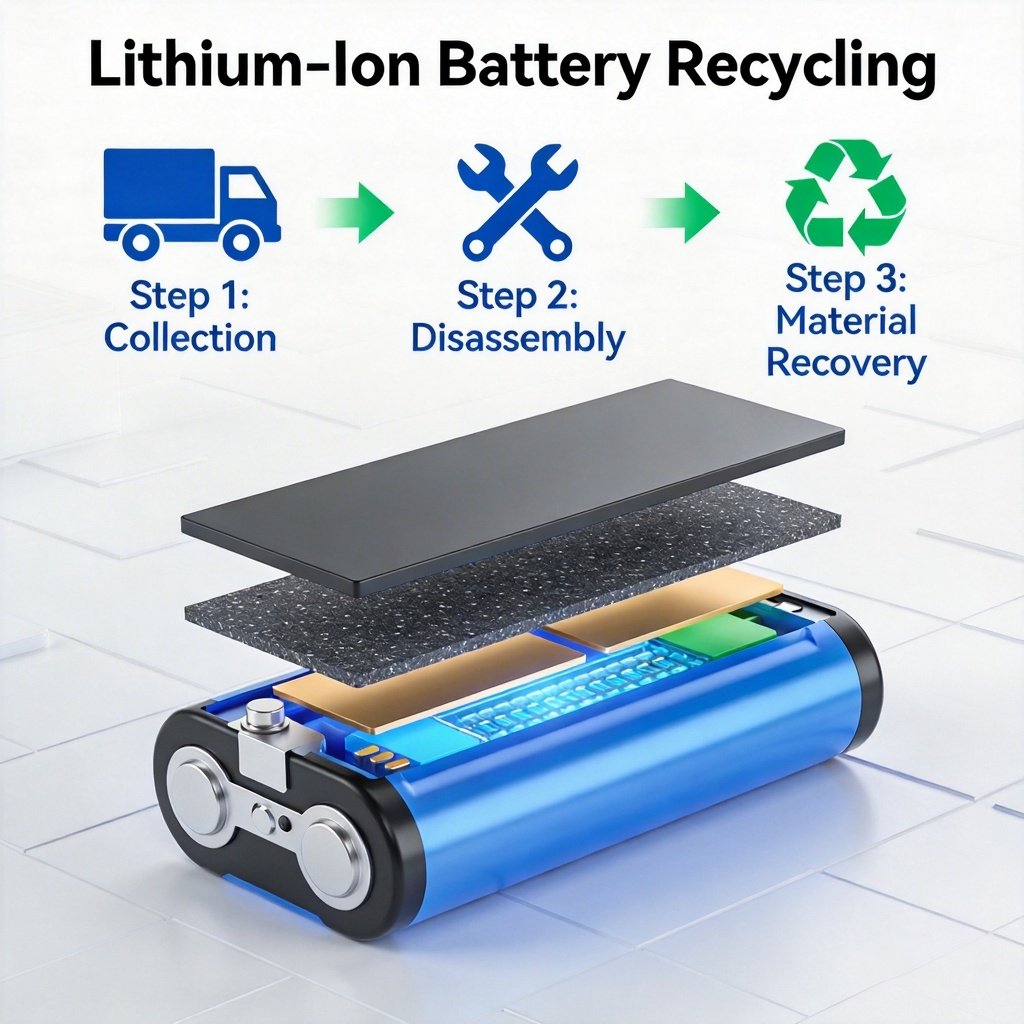
Lithium-Ion Battery Recycling Begins with Understanding Material Failure
Lithium-Ion Battery Recycling is no longer just a waste management challenge—it is a critical part of building a sustainable energy future. As electric vehicles, energy storage systems, and portable electronics continue to scale rapidly, the volume of end-of-life lithium-ion batteries is increasing at an unprecedented rate. To recycle these batteries efficiently and responsibly, it is essential to first understand how and why battery materials fail during use.
Material degradation directly determines which recycling strategy is technically feasible, economically viable, and environmentally acceptable.
Material Failure Mechanisms in Lithium-Ion Batteries
During long-term cycling, lithium-ion batteries experience irreversible changes in both structure and chemistry. These battery material failure mechanisms typically include:
- Crystal structure collapse or phase transitions in cathode materials
- Loss of active lithium due to side reactions
- Transition metal dissolution
- Surface reconstruction and particle cracking
- Increased internal resistance and capacity fade
The severity of these degradation mechanisms plays a decisive role in selecting an appropriate lithium-ion battery recycling route.
🔥 Metallurgical Recycling: Effective but Energy-Intensive
Hydrometallurgy and Pyrometallurgy
Traditional recycling methods—hydrometallurgy and pyrometallurgy—are widely used for processing severely degraded batteries.
- Pyrometallurgy involves high-temperature smelting to recover valuable metals such as cobalt, nickel, and copper. While robust, this approach is energy-intensive and results in significant carbon emissions.
- Hydrometallurgy relies on chemical leaching and precipitation to extract metals. It offers higher recovery efficiency and better compositional control but generates large volumes of chemical waste.
These metallurgical recycling routes are well suited for batteries that have suffered severe structural damage, contamination, or mixed chemistries. However, they often destroy the original crystal structure of cathode materials, resulting in downcycling rather than true material reuse.
♻️ Direct Regeneration: A Smarter Recycling Path
Recycling by Repairing, Not Rebuilding
Direct regeneration recycling represents a next-generation approach to lithium-ion battery recycling. Instead of breaking materials down to elemental form, this method focuses on repairing degraded crystal structures and restoring electrochemical performance.
Typical regeneration techniques include:
- Relithiation to replenish lost lithium
- Thermal annealing to heal lattice defects
- Surface coating to improve interfacial stability
This approach is especially effective for mildly degraded cathode materials, where the bulk crystal framework remains intact.
Advantages of Direct Regeneration Recycling
Compared with traditional metallurgical methods, direct regeneration offers several compelling advantages:
- Lower energy consumption
- Reduced chemical waste
- Preservation of material value
- Shorter recycling chains
- Compatibility with closed-loop battery recycling
By enabling recycled materials to re-enter battery production directly, regeneration methods support a true circular economy for lithium-ion batteries.
Closed-Loop Recycling Depends on Failure Analysis
The future of sustainable battery materials lies in closed-loop lithium-ion battery recycling, where end-of-life batteries become feedstock for next-generation cells. Achieving this goal requires precise diagnosis of material failure mechanisms.
Rather than applying a one-size-fits-all recycling strategy, manufacturers and recyclers must:
- Classify batteries based on degradation severity
- Match recycling methods to material condition
- Integrate diagnostics into recycling decision-making
This materials-informed approach maximizes both environmental and economic returns.
Looking Ahead: Smarter Recycling for a Battery-Powered World
As battery technologies continue to evolve, recycling strategies must evolve alongside them. Understanding battery material failure mechanisms is the foundation for selecting efficient lithium-ion battery recycling pathways—whether through metallurgical extraction or advanced direct regeneration.
By shifting from destructive recovery to intelligent repair, the industry can reduce emissions, lower costs, and secure a more sustainable supply of critical battery materials.