
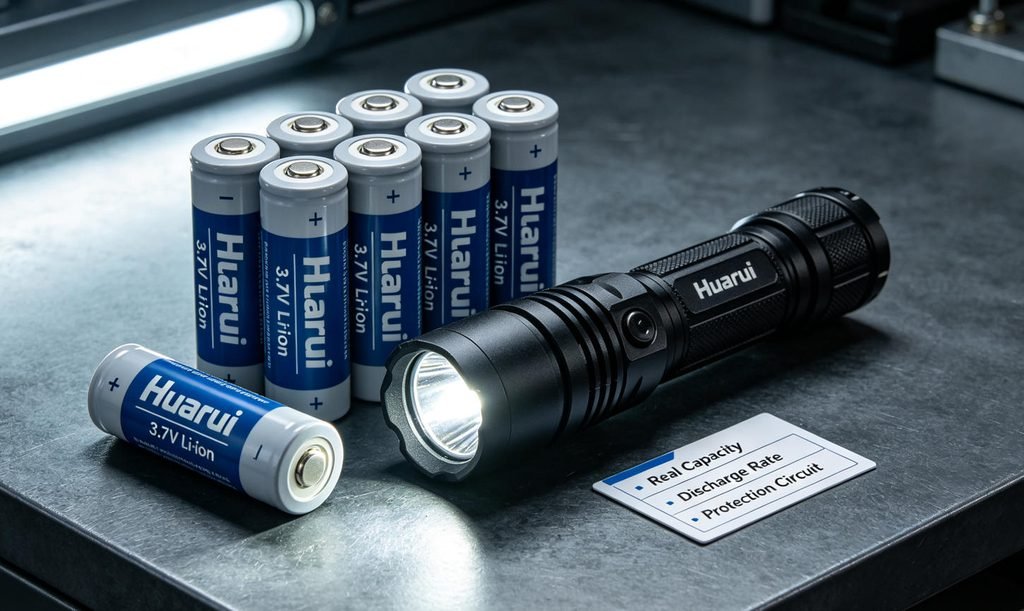
Reliable Flashlight Battery: Key Types, Specs and Common Sourcing Pitfalls
Flashlight battery selection directly determines brightness runtime, safety and total operating cost for tactical flashlights, industrial work lights, outdoor search lights and emergency illumination equipment. Many hardware manufacturers and bulk buyers only look at mAh figures while ignoring discharge performance, physical dimension mismatch and widespread capacity mislabeling on the market. Bad cell choices lead to short run‑time, overheating risks, high product return rates and unexpected project delays. This article breaks down mainstream flashlight battery types, core technical parameters and practical sourcing tips for volume purchasers.
Main flashlight battery chemistries and use‑case
Rechargeable lithium‑ion cells dominate modern high‑power LED flashlight products. They deliver high continuous discharge current, stable voltage output and hundreds of charge cycles, ideal for tactical, industrial and frequent‑use outdoor devices. Common form factors include 18650, 21700, 26650 and 14500 cylindrical cells.
Primary lithium cells such as CR123A serve emergency‑oriented flashlight applications. They feature extremely long shelf life up to 10 years, stable performance under low‑temperature environment, and require no charging maintenance. They are widely adopted for safety‑critical gear kept in vehicle kits and disaster‑preparedness supplies. Note their nominal 3V voltage cannot directly replace standard 1.5V alkaline cells; wrong installation may burn out flashlight driving circuits.
Alkaline and Ni‑MH batteries remain popular for low‑brightness consumer flashlights. They carry low unit cost and wide retail availability, yet cannot sustain heavy high‑current loads, making them unsuitable for high‑lumen tactical lighting equipment.
Critical parameters to evaluate for flashlight battery
Real usable capacity stands as the most frequently misunderstood index. Multiple marketplace suppliers mark unrealistic mAh values far above physical limits. For instance, genuine 18650 flashlight battery max real capacity sits around 3500mAh, and genuine 21700 reaches roughly 5000mAh. Any advertised figures far beyond these thresholds signal falsified labeling. Always request manufacturer datasheets and sample batch testing reports for bulk procurement.
Continuous discharge rate is vital for high‑lumen flashlights. High‑power LED modules pull large instant current. If the flashlight battery cannot match required discharge rating, output brightness will drop sharply, and cell temperature will rise significantly, raising safety hazards. For tactical high‑beam flashlights, prioritize high‑discharge grade cells instead of pure high‑capacity variants.
Physical dimension and protection circuit must match flashlight housing. Protected cells include built‑in over‑charge, over‑discharge and short‑circuit protection boards. Some compact flashlight battery compartments have limited inner space; protected cells may fail to fit, while unprotected cells bring safety risks under improper operation. Confirm mechanical drawing and protection requirements before placing large orders.
Certification compliance cannot be overlooked for cross‑border bulk orders. Qualified flashlight battery needs UN38.3 transportation approval, MSDS material safety sheet and IEC 62133 certification. Missing valid documents will cause customs hold‑up and logistics delays for overseas shipments.
Comparison of popular flashlight battery cell formats
| Cell Model | Dimension | Typical Real Capacity | Core Strength | Typical Application |
|---|---|---|---|---|
| 18650 | 18×65 mm | 2600‑3500 mAh | Balanced cost‑performance, wide compatibility | Mid‑size LED flashlights, work lights |
| 21700 | 21×70 mm | 4000‑5000 mAh | Higher energy density, longer runtime | Large‑size high‑lumen tactical flashlights |
| 26650 | 26×65 mm | 4500‑5500 mAh | Excellent discharge capability | Heavy‑duty industrial search lights |
| CR123A | 17×34.5 mm | 1400‑1600 mAh | 10‑year shelf life, primary lithium | Emergency, tactical non‑rechargeable flashlights |
Common sourcing pitfalls for flashlight battery bulk buyers
First, do not trust over‑inflated capacity labels. Many low‑cost suppliers print exaggerated mAh numbers to attract RFQ, but actual tested capacity can be 30‑50 % lower than marked value. Request third‑party test reports before mass production.
Second, distinguish protected versus unprotected flashlight battery. Unprotected bare cells offer lower cost, yet end‑users may trigger thermal risks from wrong charging or short‑circuit. Clarify protection requirements in your technical specification sheet.
Third, temperature adaptability matters for field‑use flashlights. Outdoor and tactical devices operate in cold winter or high‑temperature desert scenarios. Standard lithium‑ion cells suffer obvious capacity drop under extreme low temperature. For special‑environment projects, specify low‑temperature grade cells in your inquiry.
Fourth, verify certificate validity. Reject expired documents or certificates belonging to unrelated cell models. Valid certification files are mandatory for sea and air freight of lithium‑containing goods.
Practical selection guidance by project type
For tactical high‑lumen flashlights: Prioritize high‑discharge grade lithium‑ion cells, focus on continuous current performance rather than chasing maximum mAh.
For industrial workshop work lights: Balance cycle life and unit cost, select stable mid‑capacity 18650 or 21700 flashlight battery with complete protection circuit.
For emergency and backup flashlights: CR123A primary lithium cells deliver superior long‑storage performance when devices sit idle for months or years.
For mass‑market consumer flashlights: Adopt cost‑validated standard‑grade cells, strictly screen suppliers against capacity‑faking risks to reduce after‑sales return rate.
Final notes
Flashlight battery performance defines the real‑world experience of finished lighting products. Bulk buyers should establish clear evaluation criteria covering real capacity, discharge performance, mechanical dimension and certification documents, instead of making purchasing decisions based purely on quoted unit price. Sample testing before mass order effectively avoids large‑batch quality losses.