
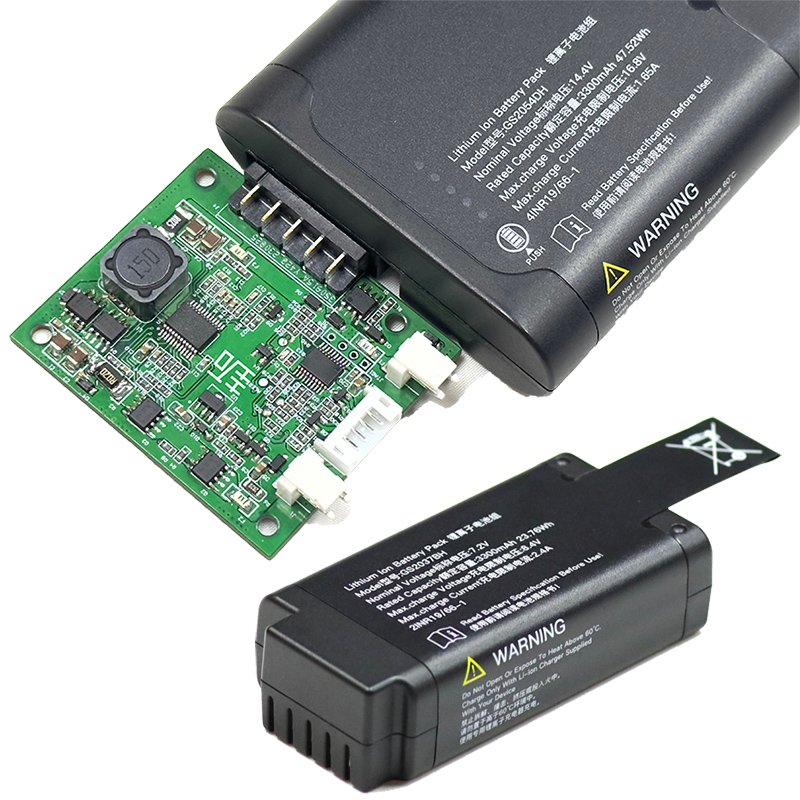
Why the Battery Protection Board Discharge Process Matters
The battery protection board discharge process plays a critical role in ensuring the safety, reliability, and lifespan of lithium-ion batteries. During battery discharge, improper voltage control can lead to over-discharge, capacity loss, internal damage, or even safety hazards.
To prevent these risks, lithium battery protection boards integrate dedicated protection ICs and MOSFETs to monitor voltage levels in real time and disconnect the load when unsafe conditions occur.
This article explains the discharge process and over-discharge protection principle of a typical battery protection board using the DW01 protection IC combined with the 8205A MOSFET as a practical example.
How the Battery Protection Board Discharge Process Works
Real-Time Voltage Monitoring During Discharge
In a standard battery protection board discharge process, the lithium cell supplies power to an external load. As discharge continues, the cell voltage gradually decreases.
- The DW01 protection IC continuously monitors the battery voltage through the R1 resistor
- Voltage detection occurs in real time to ensure the cell remains within a safe operating range
- This monitoring is essential to prevent over-discharge damage to the lithium cell
Over-Discharge Protection Principle (DW01 + 8205A Example)
Step-by-Step Discharge Control Logic
When the battery voltage drops to a predefined threshold, the protection circuit immediately reacts:
- Voltage Threshold Detection
- When the cell voltage falls to approximately 2.5V, the DW01 determines that the battery has reached an over-discharge condition
- Signal Output Shutdown
- DW01 instantly disables the output on Pin 1, pulling the voltage to 0V
- MOSFET Cut-Off Action
- With no gate voltage on Pin 5, the 8205A MOSFET switches off
- The discharge path between B− (battery negative) and P− (protection board output) is physically disconnected
- Discharge Circuit Interruption
- The battery can no longer supply current to the load
- This effectively stops the discharge process and protects the lithium cell from deep over-discharge
At this point, the battery protection board remains in an over-discharge protection state.
Recovery from Over-Discharge Protection
How the Protection Board Resets
The battery protection board discharge process does not permanently disable the battery. Recovery is automatic and safe:
- When a charger is connected across P+ and P−
- The DW01 detects charging voltage via B−
- The protection IC immediately exits over-discharge mode
- Pin 1 outputs a high-level signal again
- The 8205A MOSFET turns back on
- The connection between B− and P− is restored
Once reset, the battery begins charging normally through the protection board.
Why Over-Discharge Protection Is Critical
Effective over-discharge protection offers several key benefits:
- ✅ Prevents irreversible capacity degradation
- ✅ Avoids internal lithium plating and chemical instability
- ✅ Enhances overall battery safety
- ✅ Extends cycle life of lithium-ion cells
- ✅ Protects downstream electronic devices
Without a reliable battery protection board discharge process, lithium batteries would be far more vulnerable to failure and safety incidents.
Typical Applications of This Protection Design
The DW01 + 8205A architecture is widely used in:
- Consumer electronics battery packs
- Power banks
- Medical device batteries
- Industrial backup batteries
- Custom lithium battery packs
Its simplicity, low cost, and reliability make it a popular solution across many lithium battery applications.
Learn More About Our Battery Solutions
If you are developing or sourcing lithium battery packs with reliable protection circuitry, our engineering team can help you design optimized solutions.