
Introduction
Your robot’s performance is capped by its battery. Off-the-shelf power cells force designers to compromise on runtime, weight, and charge cycles — but robotics custom battery pack solutions remove those limits by matching chemistry, form factor, and electronics to your exact load profile. Whether you build AMRs, cobots, or humanoid platforms, a tailored pack delivers longer uptime, safer operation, and a cleaner path to certification. This guide explains what a custom approach involves and how to evaluate a battery partner.
What Are Robotics Custom Battery Pack Solutions?
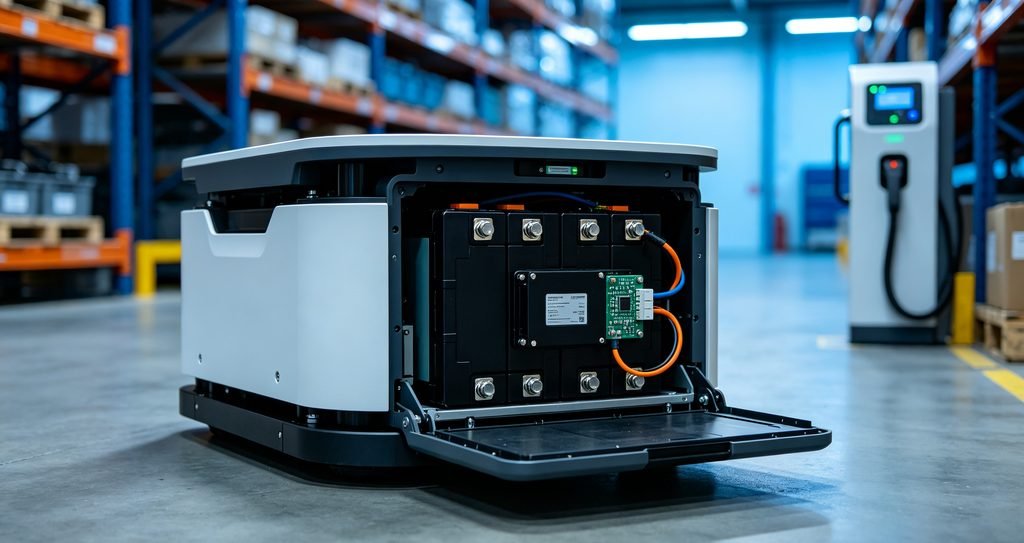
A robotics custom battery pack solution is an engineered power system built around your robot’s specifications rather than a generic retail cell. It typically combines:
- High-quality cells (18650, 21700, LiFePO4, or LiPo) selected for stable discharge rate and long cycle life
- Smart Battery Management System (BMS) that protects against overcharge, over-discharge, short circuit, and thermal runaway
- Custom mechanical design including housing, mounting structure, connectors, and IP rating to resist vibration and shock
- Robot-adaptable communication with the robot’s controller via CAN bus, SMBus, or RS485
Unlike buying cells and assembling in-house, a professional custom pack vendor handles cell matching, precision welding, full performance testing, and compliance documentation from one single source.
Why Choose Custom Battery Pack Solutions for Robotics
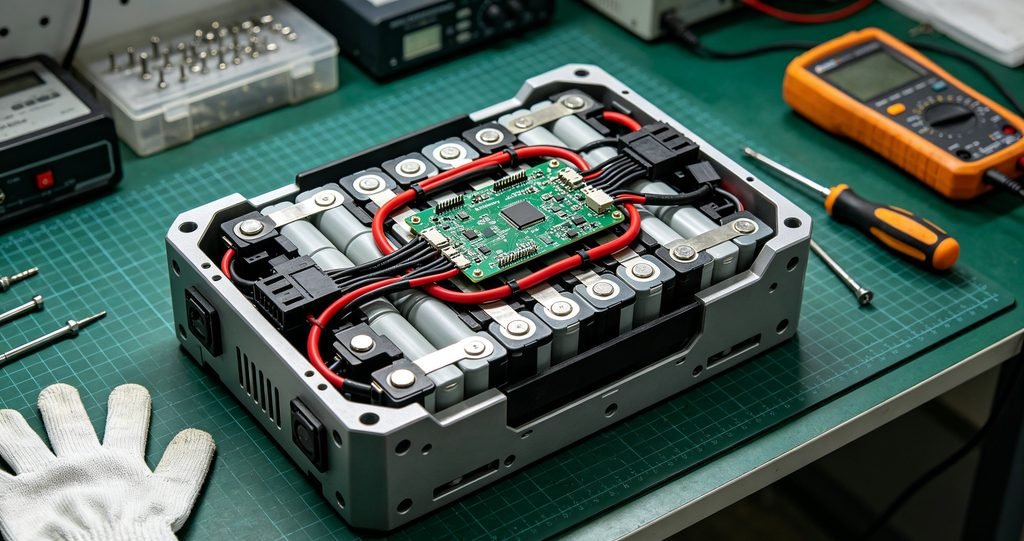
Three core reasons OEMs prefer robotics custom battery pack solutions over standard battery packs:
- Fit your duty cycle, not a catalog A delivery robot that runs 10 hours continuously requires high energy density; a robotic arm with instant 8C peak output requires strong discharge headroom. Custom chemistry and cell layout perfectly match your real working scenario.
- Maximize payload and internal space Custom-shaped battery packs fit your robot chassis cavity precisely, instead of modifying the whole robot structure for standard batteries. Slimmer and lighter custom packs effectively improve robot payload capacity and space utilization.
- Lower total cost of ownership Strictly matched cells, active cell balancing, and intelligent BMS with SOH tracking greatly extend battery cycle life and reduce field replacement frequency. This advantage is extremely critical for large-scale robot fleet deployment.
Key Factors to Consider Before Buying
When sourcing robotics custom battery pack solutions, focus on these engineering-driven factors to avoid field failure and integration issues:
- Continuous vs. peak discharge current Confirm the exact C-rate during robot acceleration, payload lifting, and climbing. Undersized batteries cause severe voltage sag and unexpected BMS power cutoff during tasks.
- Voltage and capacity window Custom nominal voltage (24V, 36V, 48V) must fully match motor driver parameters; accurate capacity configuration ensures stable robot runtime without energy waste.
- Wide operating temperature adaptability Warehouse low-temperature zones, outdoor sunlight exposure, and high-temperature workshops require customized cell selection plus optional heating or active cooling modules.
- BMS communication and charging strategy Customizable CAN bus protocol, standard CC-CV charging profile, and support for fast charging & auto-docking opportunity charging for unmanned fleet operation.
- Safety and global compliance Verify complete certification standards including UN38.3, IEC 62133, and UL certifications to meet different regional market access requirements.
- Prototype lead time and mass production stability Fast prototype delivery supports robot R&D iteration, while consistent batch quality ensures zero-difference performance in large-volume deployment.
Applications and Industries
Robot custom battery solutions serve a full range of automated equipment across industrial and commercial scenarios:
- Warehouse AMRs & Factory AGVs: Support hot-swap battery and opportunity fast charging for 24/7 fleet operation
- Collaborative Robots (Cobots): Compact high-discharge custom packs for high-frequency articulated arm movement
- Service & Delivery Robots: High-energy-density packs for long-shift indoor and outdoor operation
- Inspection & Agricultural Robots: Rugged waterproof and dustproof battery packs adapting to complex temperature and humidity changes
- Humanoid & Legged Robots: Lightweight, high-power-density custom batteries supporting fast charging and dynamic movement
- Medical & Surgical Robots: High-safety certified battery packs with redundant protection and complete data logging records
Technology, Safety, and Certification
Reliable robotics custom battery pack solutions adopt standardized safety technology and global compliance systems:
- Intelligent BMS with real-time cell balancing ensures safe fast charging and long battery lifespan (Learn more about lithium-ion battery safety).
- Fully compliant with UN dangerous goods transport standards to support global air and sea shipping (ICAO dangerous goods regulations).
- Product safety certification refers to official IEC battery standards, with optional UL 2271 / UL 2054 certification for North American markets (IEC official website).
- ISO 9001 quality management system and complete cell traceability ensure stable mass production quality and accurate failure analysis.
Always require suppliers to providebatch-specific certification documents instead of generic qualification certificates for your target market.
FAQ About Robotics Custom Battery Pack Solutions
Q1: How long does a custom robot battery take to develop?
Typically 4–8 weeks from spec confirmation to functional prototype, plus 2–4 weeks for reliability qualification testing, depending on project complexity.
Q2: Which battery chemistry is best for robots?
NMC delivers the best energy-to-weight balance for most mobile robots; LiFePO4 is ideal for scenarios prioritizing ultra-long cycle life and thermal safety; LiPo fits ultra-compact high-discharge robot designs.
Q3: Can you build a hot-swappable battery for AMRs?
Yes. Most robotics custom battery pack solutions support hot-swap function, auto-docking opportunity charging, customized mechanical guides and dedicated BMS logic.
Q4: What is the typical cycle life of custom robot batteries?
With professional BMS protection and reasonable depth of discharge, NMC packs achieve 500–1,000 cycles, while LiFePO4 packs reach 2,000–3,500 cycles (80% residual capacity).
Q5: Do you support CAN bus communication?
Yes. Custom robot battery packs support CANopen, SMBus, and RS485 protocols, with complete protocol documents for robot controller secondary development.
Q6: What certifications are provided?
Standard delivery includes UN38.3 test reports, MSDS, IEC 62133 certification, CE and RoHS declarations. We can provide targeted certificates according to your sales region.
Conclusion
Robotics custom battery pack solutions are not an upgrade luxury — they are the core guarantee of stable robot operation. By customizing cell chemistry, BMS logic, mechanical structure and certification schemes according to your real duty cycle, professional battery suppliers help robot OEMs shorten time to market and improve field operation reliability.
Ready to power your next robot project? Contact our engineering team for a free custom battery solution consultation, or browse our custom battery product series to view complete specifications for robotic power systems.