
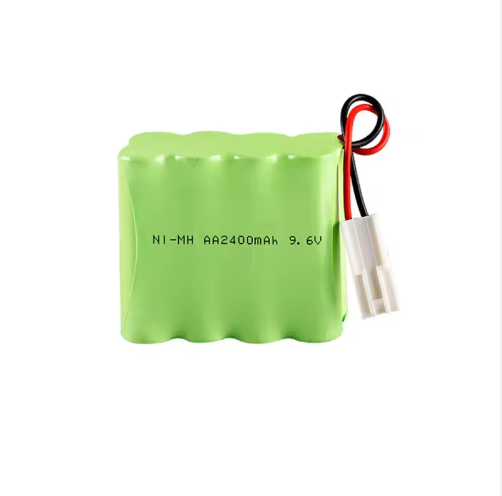
A 9.6v nimh custom battery pack consists of eight 1.2V NiMH cells connected in series, delivering stable 9.6V nominal output for many portable industrial and hobby devices. Off‑the‑shelf 9.6V NiMH packs often fail to match unique enclosure dimensions, connector requirements or special working conditions. For OEM buyers and equipment manufacturers, working with a supplier to build a proper 9.6v nimh custom battery pack avoids compatibility issues and improves end‑product reliability.
This article covers four core factors you need to evaluate when sourcing a 9.6v nimh custom battery pack, helping engineering and procurement teams make informed bulk purchase decisions.
1. Cell Configuration and Capacity Customization
Standard 9.6v nimh custom battery pack adopts 8S1P series configuration. Buyers can select AA, AAA, SC or 2/3A cell sizes according to available installation space and target capacity, ranging from 800mAh up to 3000mAh and above.
Custom options include adjusting series‑parallel layout, changing pack shape, flat layout or stick‑type layout to fit limited device housing. Experienced manufacturers sort cells strictly by internal resistance, voltage and capacity before assembly. Well‑matched cells reduce capacity drift and extend overall cycle life of the finished battery pack.
Many sourcing mistakes happen when buyers only focus on mAh value, ignoring cell grade and consistency. Low‑grade mixed cells will cause early swelling, fast self‑discharge and inconsistent runtime across batch units.
2. Connector, Wiring and Mechanical Customization
One major reason to order a 9.6V NiMH custom battery pack is to match device interface requirements. Common custom items include connector types such as Tamiya, JST, Molex and other custom pin definitions, adjustable wire gauge and wire length, plus PVC shrink or hard plastic housing options.
Different end‑devices require different mechanical forms. RC models often need flat or stick‑shaped packs, while portable test instruments may request compact block‑style assemblies. A qualified supplier can adjust physical dimensions without altering the 9.6V electrical performance.
Protection circuits can also be integrated upon request, adding over‑charge, over‑discharge and over‑temperature protection for equipment working in unstable environments.
3. Application‑Driven Performance Requirements
9.6V NiMH custom battery pack is widely used across multiple sectors. Typical applications include RC hobby models, airsoft devices, portable measuring instruments, backup power modules and handheld industrial equipment.
- High‑discharge scenarios: RC and airsoft devices demand stable high‑current output, requiring power‑grade NiMH cells.
- Instrument backup power: Low self‑discharge cells are preferred to maintain long standby time.
- Indoor & moderate outdoor use: Standard‑grade cells work well under normal temperature conditions.
Share your device working current, operating temperature range and target cycle life with your supplier. This helps them select the right cell grade for your 9.6v nimh custom battery pack, instead of using generic off‑the‑shelf components.
4. Quality Control and Mandatory Certifications
Even for a 9.6V NiMH custom battery pack, full compliance documentation is essential for cross‑border shipments and market access. Reliable suppliers provide EN 62133, IEC 63115‑1, RoHS, REACH, UN38.3 and MSDS documents for each batch.
Every finished pack should go through open‑circuit voltage testing, charge‑discharge cycling and aging inspection to guarantee batch consistency. You can review NiMH battery safety standards via the official IEC international standard website.
Avoid suppliers who cannot provide complete test reports. Sample performance can look good, yet mass‑produced units may suffer from poor welding, loose connections, or unqualified cells.
Common Sourcing Pitfalls for 9.6V NiMH Custom Battery Pack
- Confusing physical size with actual capacity: Cheap packs may use low‑capacity cells inside large housings.
- Ignoring connector polarity: Wrong pin‑out will damage your device after installation.
- No cell matching process: Poorly matched cells lead to rapid performance drop‑off after limited cycles.
- Missing required certification files: Risk of customs hold or product recall in European and North American markets.
Custom 9.6V NiMH Pack vs Ready‑Made 9.6V NiMH Pack
Standard ready‑made 9.6V NiMH battery packs are cost‑effective for general replacement projects. However, when your device has special enclosure size, unique connector pin‑out, specific discharge requirements or needs full OEM branding, a 9.6v nimh custom battery pack is the practical solution. Customized units reduce modification work on your end‑product and lower long‑term failure rates.
Conclusion
When sourcing a 9.6v nimh custom battery pack, focus not only on voltage and capacity numbers, but also on cell consistency, mechanical customization, application‑oriented performance and complete certification support. A well‑customized battery pack improves end‑product stability and reduces after‑sales issues for your OEM projects.
If you need engineered 9.6v nimh custom battery pack solutions for your portable devices, get in touch for technical review and quotation.
FAQs
1. How many cells make up a 9.6V NiMH battery pack?
A standard 9.6v nimh custom battery pack uses eight 1.2V NiMH cells connected in series (8S configuration) to achieve nominal 9.6V output.
2. What capacity options are available for custom 9.6V NiMH packs?
Capacity ranges widely from 800mAh up to 3000mAh or higher, determined by AA, AAA or SC cell types, subject to your size constraints.
3. Can I add protection circuit to my custom 9.6V NiMH pack?
Yes. Over‑charge, over‑discharge and thermal protection circuits can be integrated into the 9.6v nimh custom battery pack according to project requirements.